

3 Min Read What Is Aerodynamics? (Grades K-4)  This article is for students grades K-4.
What Are the Four Forces of Flight? Aerodynamics is the way air moves around things. The rules of aerodynamics explain how an airplane is able to fly. Anything that moves through air reacts to aerodynamics. A rocket blasting off the launch pad and a kite in the sky react to aerodynamics. Aerodynamics even acts on cars, since air flows around cars.
The four forces of flight are lift, weight, thrust and drag. These forces make an object move up and down, and faster or slower. How much of each force there is changes how the object moves through the air.
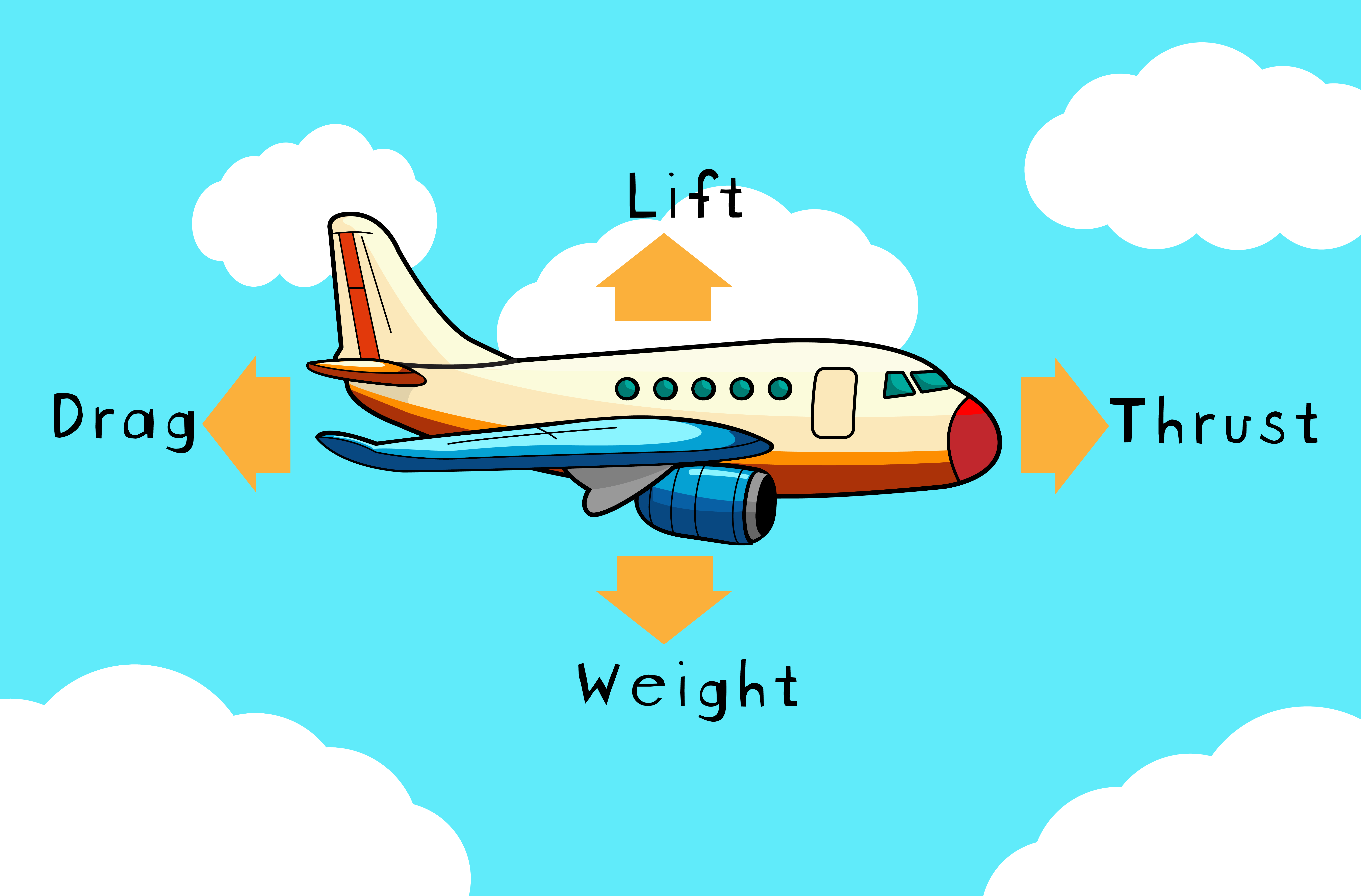 What Is Weight? Everything on Earth has weight. This force comes from gravity pulling down on objects. To fly, an aircraft needs something to push it in the opposite direction from gravity. The weight of an object controls how strong the push has to be. A kite needs a lot less upward push than a jumbo jet does.
 What Is Lift? Lift is the push that lets something move up. It is the force that is the opposite of weight. Everything that flies must have lift. For an aircraft to move upward, it must have more lift than weight. A hot air balloon has lift because the hot air inside is lighter than the air around it. Hot air rises and carries the balloon with it. A helicopter’s lift comes from the rotor blades at the top of the helicopter. Their motion through the air moves the helicopter upward. Lift for an airplane comes from its wings.
 How Do an Airplane’s Wings Provide Lift? The shape of an airplane’s wings is what makes it able to fly. Airplanes’ wings are curved on top and flatter on the bottom. That shape makes air flow over the top faster than under the bottom. So, less air pressure is on top of the wing. This condition makes the wing, and the airplane it’s attached to, move up. Using curves to change air pressure is a trick used on many aircraft. Helicopter rotor blades use this trick. Lift for kites also comes from a curved shape. Even sailboats use this concept. A boat’s sail is like a wing. That’s what makes the sailboat move.
What Is Drag? Drag is a force that tries to slow something down. It makes it hard for an object to move. It is harder to walk or run through water than through air. That is because water causes more drag than air. The shape of an object also changes the amount of drag. Most round surfaces have less drag than flat ones. Narrow surfaces usually have less drag than wide ones. The more air that hits a surface, the more drag it makes.
 What Is Thrust? Thrust is the force that is the opposite of drag. Thrust is the push that moves something forward. For an aircraft to keep moving forward, it must have more thrust than drag. A small airplane might get its thrust from a propeller. A larger airplane might get its thrust from jet engines. A glider does not have thrust. It can only fly until the drag causes it to slow down and land.

