2 Min Read SPARCS CubeSat ‘First Light’ Images  PIA26731 Credits:
NASA/JPL-Caltech/ASU Photojournal Navigation Science Photojournal SPARCS CubeSat ‘First… Photojournal Home Photojournal Search Latest Content Galleries Feedback RSS About Downloads SPARCS CubeSat ‘First Light’ Images
PNG (1.73 MB)
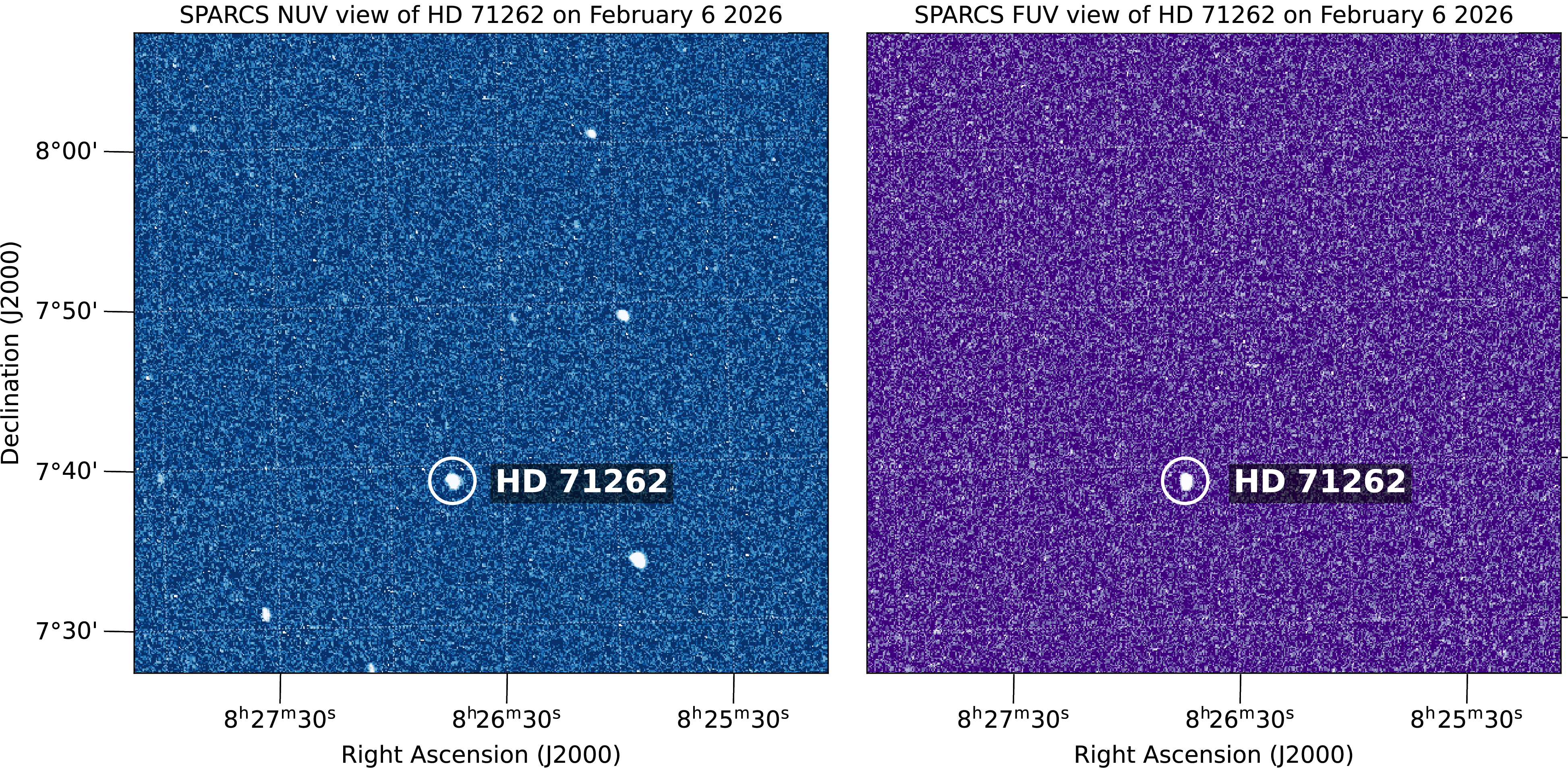
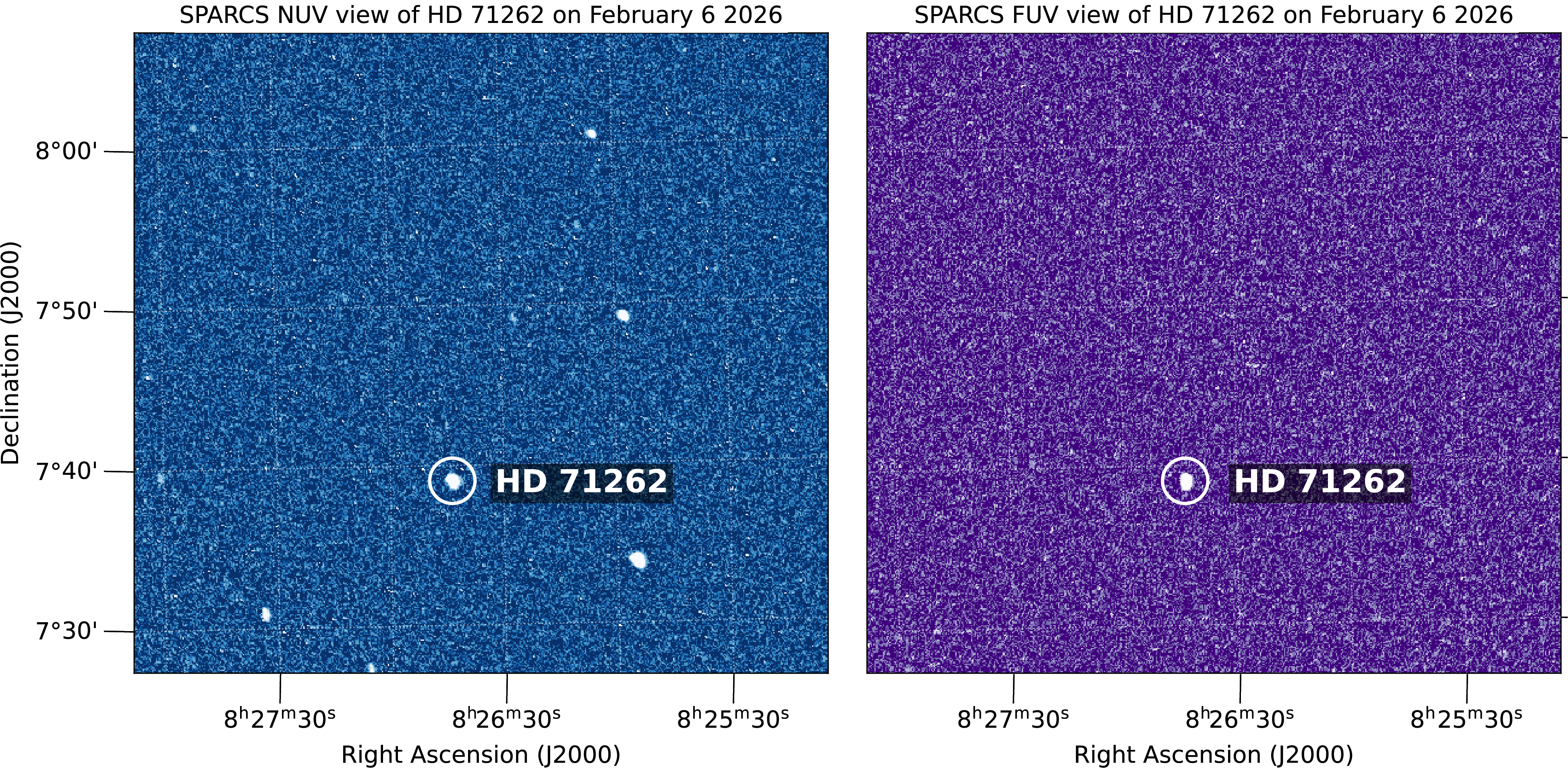
Description This pair of images shows stars observed by the SPARCS (Star-Planet Activity Research CubeSat) space telescope simultaneously in the near-ultraviolet, left, and far-ultraviolet, right. These observations were recorded on Feb. 6, 2026, three weeks after the cube satellite, or CubeSat, launched aboard a SpaceX Falcon 9 on Jan. 11. The fact that one star is seen in the far-UV while multiple are seen in near-UV offers insights into the temperatures of these stars, with the one visible in both colors being the hottest.
Roughly the size of a large cereal box, SPARCS will monitor flares and sunspot activity on low-mass stars — objects only 30% to 50% the mass of the Sun. These stars are among the most common in the Milky Way and host the majority of the galaxy’s roughly 50 billion habitable-zone terrestrial planets, which are rocky worlds close enough to their stars for temperatures that could allow liquid water and potentially support life.
The SPARCS spacecraft is the first dedicated to continuously and simultaneously monitoring the far-ultraviolet and near-ultraviolet radiation from low-mass stars. Over its one-year mission, SPARCS will target approximately 20 low-mass stars and observe them over durations of five to 45 days.
Filters for the spacecraft’s camera, SPARCam, were made using a technique that improves sensitivity and performance by enabling them to be directly deposited onto the specially developed UV-sensitive “delta-doped” detectors. The approach of detector-integrated filters eliminated the need for a separate filter element, resulting in a system that is among the most sensitive of its kind ever flown in space.
The filters, detectors, and associated electronics were designed, fabricated, and tested at the Microdevices Laboratory (MDL) at NASA’s Jet Propulsion Laboratory in Southern California. Inventors at MDL harness physics, chemistry, and material science, including quantum, to deliver first-of-their-kind devices and capabilities for our nation.
Funded by NASA and led by Arizona State University in Tempe, SPARCS is managed under the agency’s Astrophysics Research and Analysis program. The agency’s CubeSat Launch Initiative (CSLI) selected SPARCS in 2022 for a ride to orbit. The initiative is a low-cost pathway for conducting scientific investigations and technology demonstrations in space, enabling students, teachers, and faculty to gain hands-on experience with flight hardware design, development, and building.
Blue Canyon Technologies fabricated the spacecraft bus.
Keep Exploring Discover More Topics From Photojournal Photojournal