
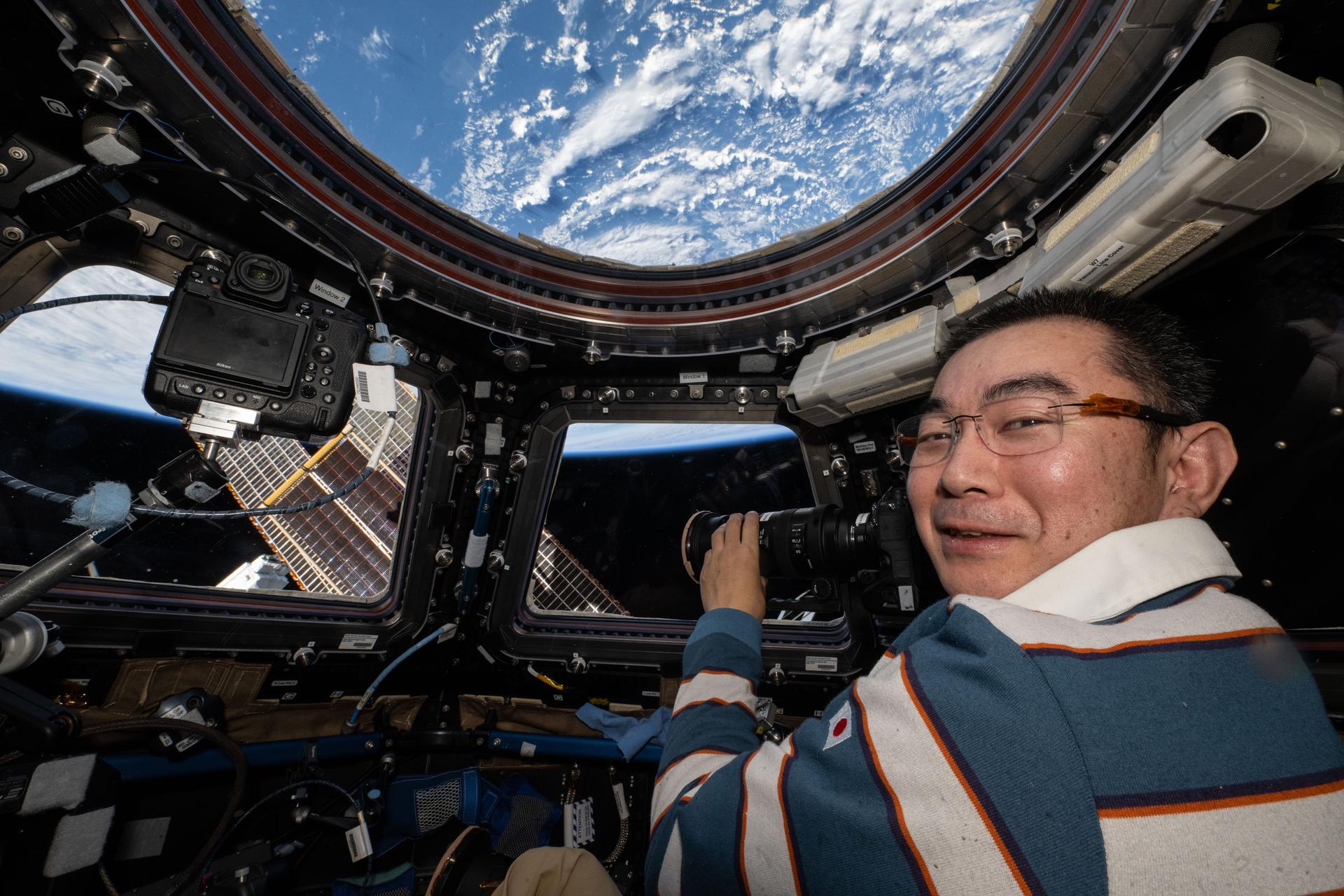

The Expedition 74 crew wrapped up the week exploring how the body balances itself in space and growing stem cells to improve health. Meanwhile, ongoing cargo operations and lab maintenance rounded out the schedule aboard the International Space Station.
Scientists are investigating how a crew member’s sense of balance, movement, posture, and visual stability adapts to living in weightlessness. They are looking at potential space-caused changes to the brain’s network, or vestibular system, when interpreting motion, position, and equilibrium in space. Results may improve astronaut training and benefit therapies for patients on Earth.
NASA Flight Engineer Chris Williams wore virtual reality goggles on Friday and responded to visual cues sent from a computer operated by NASA Flight Engineer Zena Cardman. The duo worked inside the Columbus laboratory module as doctors on the ground remotely guided the astronauts during the vestibular portion of the CIPHER human research experiment.
Williams later worked out for the exercise portion of the CIPHER study, this time looking at his cardiorespiratory fitness, muscle strength, and endurance. Cardman treated and preserved stem cells growing in space to demonstrate their superiority to those manufactured on Earth and advance a wide range of patient therapies including regenerative medicine.
Roscosmos Flight Engineers Sergey Kud-Sverchkov and Sergei Mikaev also explored how a crew member’s vestibular system adapts to microgravity for their space agency’s Virtual experiment. They took turns wearing a different set of virtual reality goggles that tracked their vision helping researchers understand a crew member’s sensory interactions in weightlessness. Roscosmos scientists will also use the data to train crews for future missions and prepare them for the return Earth’s gravity.
Flight Engineer Kimiya Yui installed six material sample carriers inside the Kibo laboratory module’s airlock on Friday for robotic installation on the outside of the orbital outpost next week. The carriers house materials that will be exposed to space radiation, extreme temperature changes, and more to benefit a variety of Earth and space industries.
Station Commander Mike Fincke of NASA spent the end of the week on cargo and maintenance. Fincke first loaded cargo for disposal inside JAXA’s HTV-X1 cargo craft that will depart the station’s Earth-facing port on the Harmony module in late January. Afterward, he replaced pipes in the Tranquility module’s waste and hygiene compartment, also known as the space station’s bathroom.
Roscosmos Flight Engineer Oleg Platonov kicked off his day on orbital plumbing maintenance before moving on and photographing scientific hardware for analysis on the ground.
Learn more about station activities by following the space station blog, @space_station on X, as well as the ISS Facebook and ISS Instagram accounts.
Get the latest from NASA delivered every week. Subscribe here.