
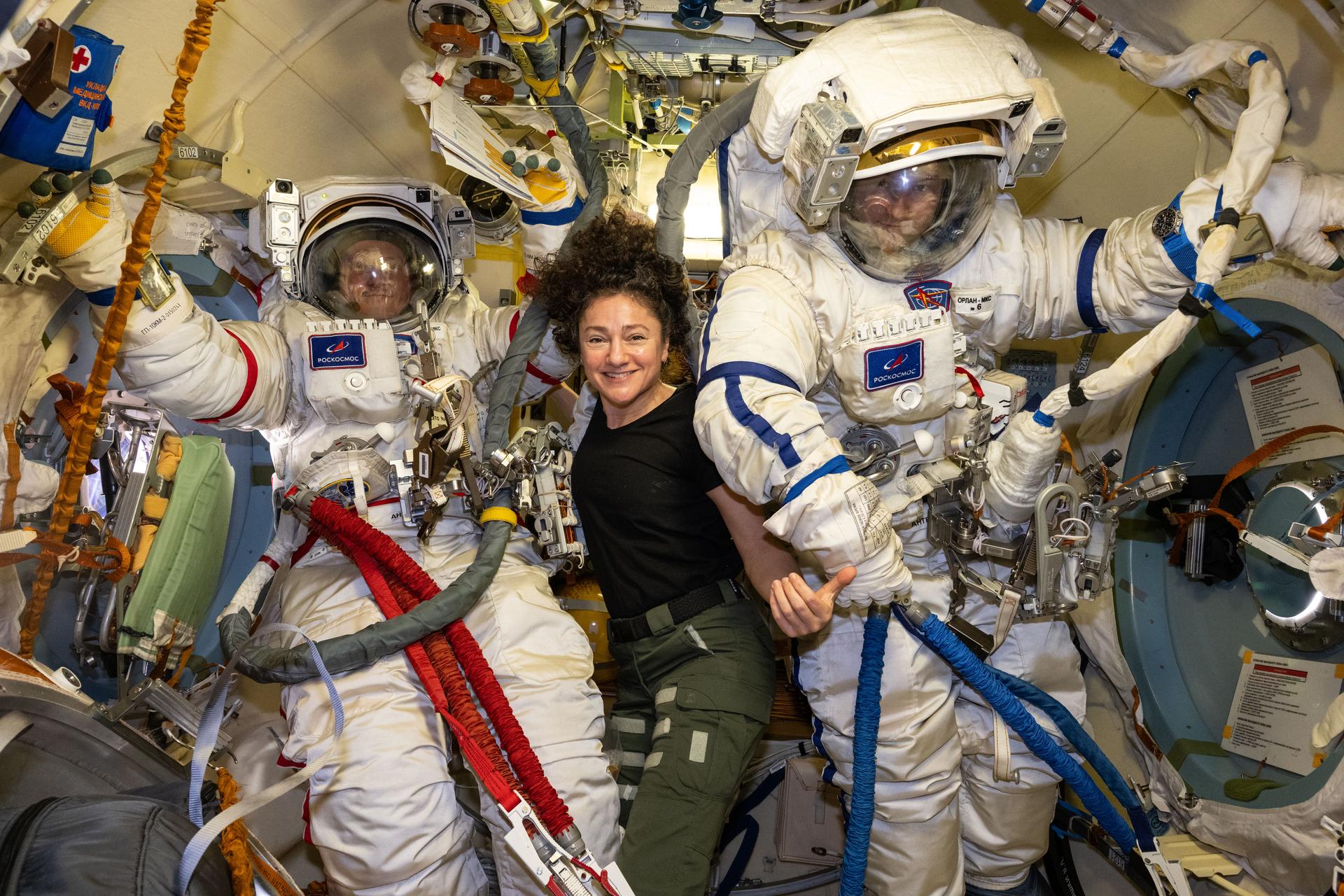

Robotics controllers wrapped up a weekend of swapping scientific hardware packed inside the SpaceX Dragon cargo spacecraft’s trunk for installation on the International Space Station. Meanwhile, the Expedition 74 crew is continuing its biotechnology and botany research while getting ready for a spacewalk scheduled for Wednesday, May 27.
The orbital outpost hosts a new Earth-observing research facility, the CLARREO Pathfinder, designed to improve satellite imagery and research data accuracy. CLARREO was delivered on May 17 inside Dragon’s unpressurized trunk. It was removed with the Canadarm2 robotic arm, remotely controlled by engineers on Earth, over the Memorial Day weekend and installed on the station’s port side truss structure. Early last week, another research payload, the Space Test Program-Houston 11, was robotically removed from Dragon and installed on the outside of the Columbus laboratory module. The multi-experiment facility will test new space technologies, measure the space environment, and support a variety of research.
A multitude of experiments is also underway inside the orbiting lab with Tuesday’s science schedule packed with biotechnology and space botany to improve health on and off the Earth.
NASA flight engineer Jessica Meir opened up the Life Science Glovebox in the Kibo laboratory module and nourished cartilage-forming cells. The cells are growing into tiny pieces of cartilage tissue to help doctors understand how cartilage develops and repairs itself in microgravity. Results may improve astronaut fitness regimens and promote the development of advanced implants on Earth.
NASA flight engineers Chris Williams and Jack Hathaway each had a unique photography session for two different botany investigations on Tuesday. Williams took pictures of white clover seeds that will be returned to Earth so students can plant them for studying. Hathaway watered and photographed alfalfa plants growing inside the Columbus laboratory module’s Veggie facility for the Veg-06 study to help plants thrive in microgravity and promote food production in space.
Flight engineer Sophie Adenot of ESA (European Space Agency) spent her shift servicing a variety of advanced research hardware. Adenot first connected the Echo Finder-2 ultrasound device to a computer tablet then configured the biomedical device’s performance and wi-fi connectivity. Next, she installed experiment containers, or modules that house biological samples, inside the BioLab that enables microbiology research in weightlessness. Afterward, she checked out the functionality of a portable DNA sequencer and updated the device’s software to support an anti-bacterial investigation.
Cosmonauts Sergey Kud-Sverchkov and Sergei Mikaev are ready for a spacewalk to install a solar radiation experiment and remove other scientific hardware on the outside of the space station. The Roscosmos duo will exit the Poisk module’s airlock at 10:15 a.m. EDT on Wednesday in their Orlan spacesuits with live NASA+ coverage beginning at 9:45 a.m. The pair’s main task will be installing a new experiment that will observe the Sun’s terahertz electromagnetic during events such as solar flares and coronal mass ejections. The cosmonaut duo completed a spacewalk task review and finalized the configuration of their spacewalking tools on Tuesday.
Roscosmos flight engineer Andrey Fedyaev will assist his spacewalking crewmates on Wednesday as he controls the European robotic arm (ERA) from inside the Nauka science module. Fedyaev will use the ERA to help retrieve the Biorisk experiment container housing biological samples exposed to the harsh external microgravity environment. Fedyaev readied the ERA for service positioning it in its pre-spacewalk configuration on Tuesday.
Learn more about station activities by following the space station blog, @space_station on X, as well as the ISS Facebook and ISS Instagram accounts.
Get the latest from NASA delivered every week. Subscribe here.