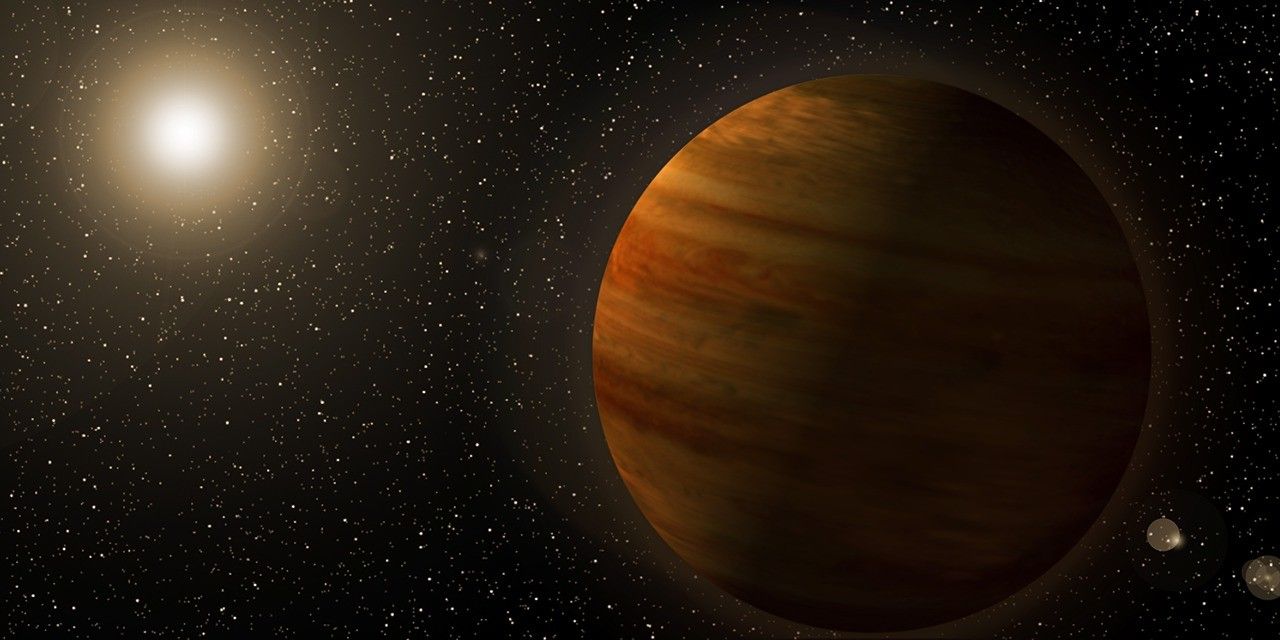
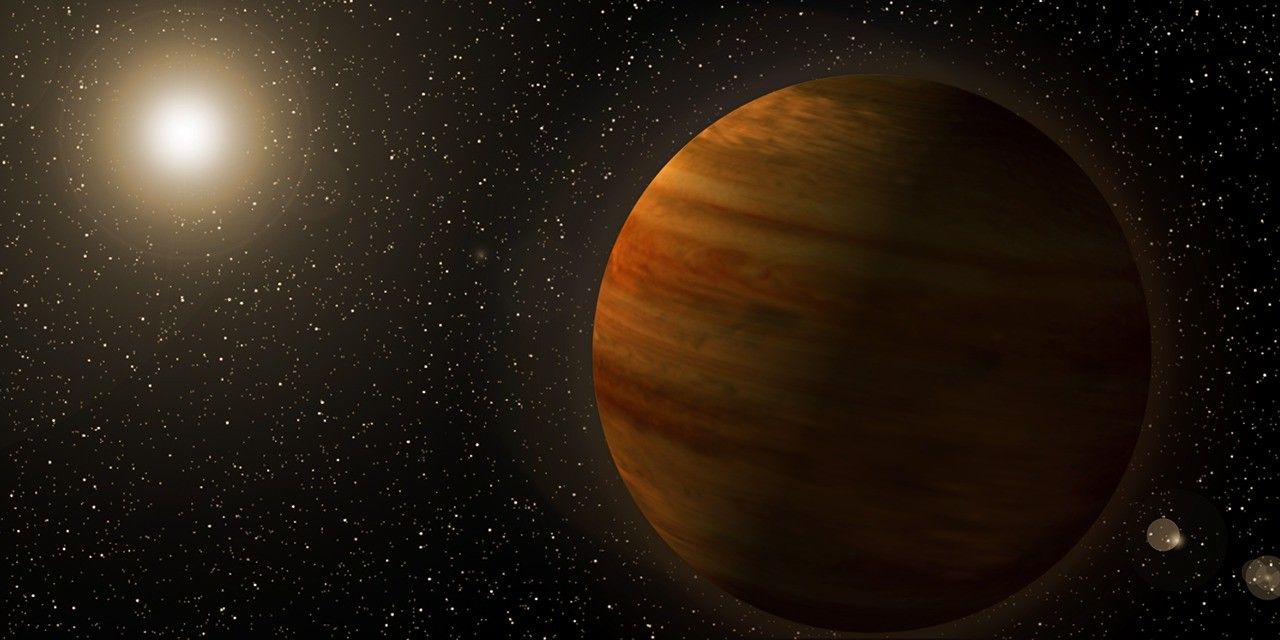
5 Min Read NASA’s TESS Mission Finds Planetary System in New Way 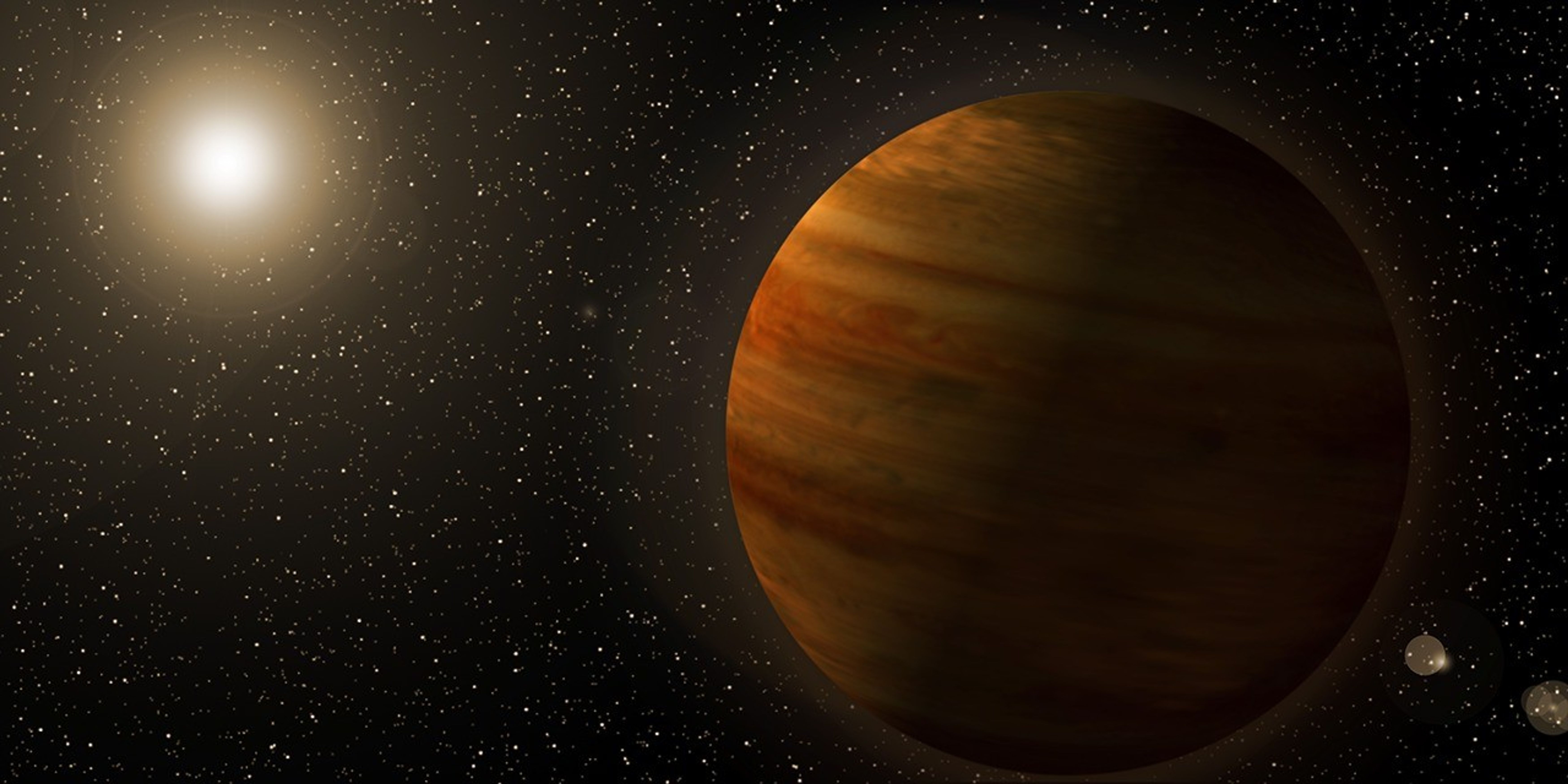 This artist’s concept visualizes a super-Jupiter orbiting an orange dwarf star at a distance similar to Jupiter’s distance from the Sun. Credits:
NASA’s Goddard Space Flight Center For the first time, NASA’s TESS (Transiting Exoplanet Survey Satellite) mission has identified a planet orbiting a distant star thanks to ripples in space-time. Unlike the star-hugging transiting planets TESS regularly reveals, the newfound world is a super-Jupiter orbiting far from its host star.
“When TESS launched, no one expected it to ever be capable of finding this kind of planet,” said Diana Dragomir, a professor at the University of New Mexico in Albuquerque and co-author of a paper describing the results. At 1.6 times Jupiter’s mass and a similar orbital distance, it would be extremely unlikely to find such a planet via the primary detection method TESS was designed for. “The discovery implies that there are probably other so-called microlensing planets hiding in TESS’s data that we hadn’t previously thought to look for.”
This artist’s concept visualizes Gaia23bra b, the first microlensing planet orbiting a distant star found by NASA’s TESS (Transiting Exoplanet Survey Satellite). This super-Jupiter orbits an orange dwarf star at a distance similar to Jupiter’s distance from the Sun. NASA’s Goddard Space Flight Center Astronomers found the first hint of the planet, called Gaia23bra b, in 2023 using ESA’s (European Space Agency) now-retired Gaia space telescope. Gaia’s alert system flagged a star that brightened — something that can happen when a foreground star passes in front of a more distant one and magnifies its light through gravitational microlensing.
Researchers later looked back through archived TESS data and found TESS had caught it too.
“Gaia’s observations were too sparse to pick up on the planet,” said Mallory Harris, a Ph.D. candidate at the University of New Mexico, who led the study. “The TESS spacecraft happened to be monitoring the same area of the sky during the event, and its denser time coverage showed extra features in the light curve caused by a planet.”
The team’s analysis, published July 1 in The Astrophysical Journal Letters, revealed that Gaia23bra b, which orbits an orange dwarf star that’s about 80 percent of the Sun’s mass, is nearly 40,000 light-years away from Earth, far exceeding TESS’s usual search radius of about 150 light-years.
Microlensing 101 Out of more than 6,000 known exoplanets (worlds outside our solar system), about three-fourths were discovered via the transit method, TESS’s typical planet-hunting technique. Astronomers monitor hordes of stars, watching for ones that periodically dim as orbiting planets cross in front of them — an event called a transit.
 This animation illustrates the concept of gravitational microlensing. When one star in the sky (shown in the center of the animation) appears to pass nearly in front of another (located in the dashed circle at the right) from our vantage point, the light rays of the background star become bent due to the warped space-time around the foreground star. This star acts like a virtual magnifying glass, amplifying the brightness of the background star and causing its position to appear to slightly shift. If the nearer star harbors a planetary system, then those planets can also act as lenses, each one producing a short deviation in the brightness of the source. When astronomers find planets this way, they can measure their mass and orbital distance from their host star. NASA’s Goddard Space Flight Center/CI Lab Microlensing has revealed less than 5% of known exoplanets. This light-bending phenomenon occurs when two stars align closely from our vantage point. Light from the more distant star curves as it travels through the warped space-time caused by the nearer star’s mass.
If the alignment is especially close, the nearer star acts like a cosmic lens, focusing and magnifying light from the background star. Planets orbiting the foreground star may also modify the distant star’s light, acting as their own tiny lenses. Astronomers see the effect as a spike in the star’s brightness.
The transit method is best at finding large planets orbiting very close to their host stars; large planets block the most starlight, while close-in planets are more likely to pass in front of the host star. These gargantuan, steamy worlds are fascinating to scientists, but astronomers want to find planets like those in our solar system, too. That’s microlensing’s specialty.
With microlensing, we can find smaller planets with greater orbital distances, including worlds in the habitable zone of their star and even farther away.  Mallory harris
Ph.D. candidate at the University of New Mexico
Microlensing isn’t well suited to finding huge, close-in planets because their gravitational signals would just blur together.
“Transits and microlensing are complementary because they each reveal a category of planet the other may not be able to detect,” Dragomir said. “And they offer different details. Transits give us the size of a planet, and in concert with other methods we can determine its mass and density. Microlensing gives us masses and orbital distances for planets we’d otherwise never see.”
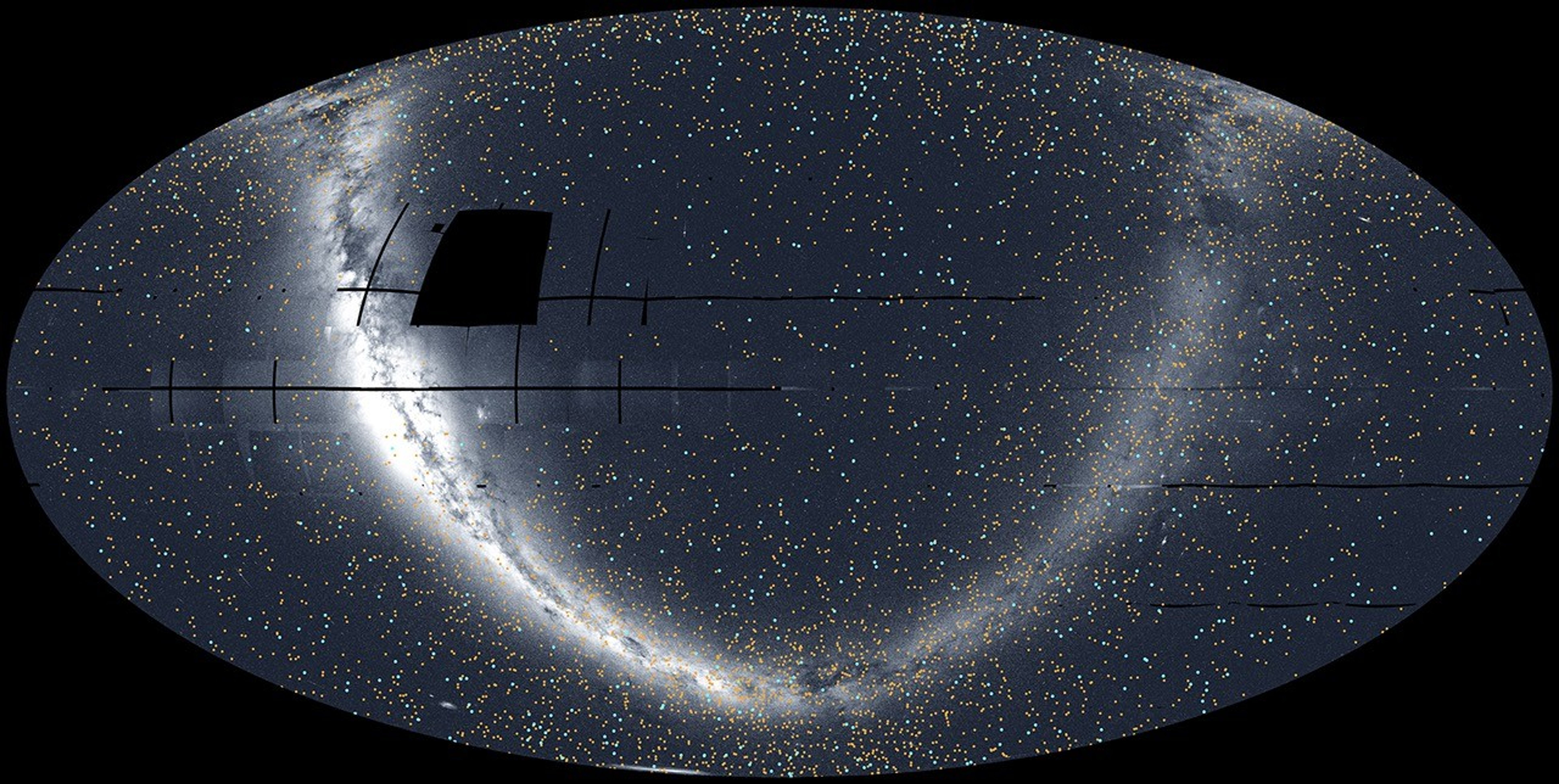
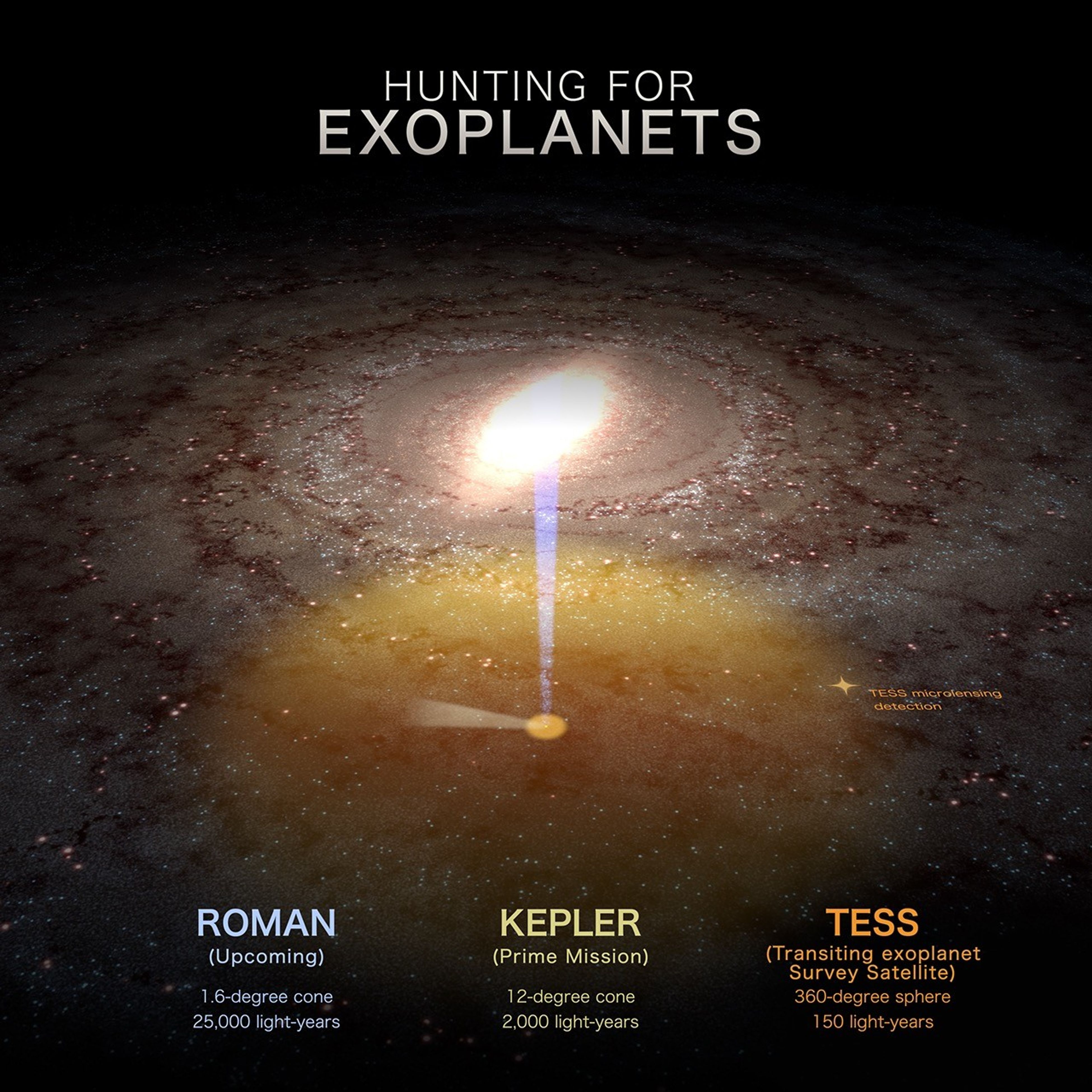 This graphic highlights the search areas of three planet-hunting missions: NASA’s upcoming Nancy Grace Roman Space Telescope, the retired Kepler Space Telescope, and NASA’s TESS (Transiting Exoplanet Survey Satellite). While TESS discovers transiting planets within a 150-light-year radius of Earth, it recently detected a planet about 40,000 light-years away (marked by the star symbol) via another method, called microlensing. NASA’s Goddard Space Flight Center But microlensing observations are time-limited opportunities.
Microlensing events happen once and they’re gone — they don’t repeat. I like to joke that we’ll probably find the first Earth analog with microlensing, and then wave at it as it goes by because we’ll never see it again. Mallory Harris
Ph.D. candidate at the University of New Mexico
That makes detailed observations of microlensing planets tough. However, the method can serve as a powerful demographics tool that offers broad information about planetary populations.
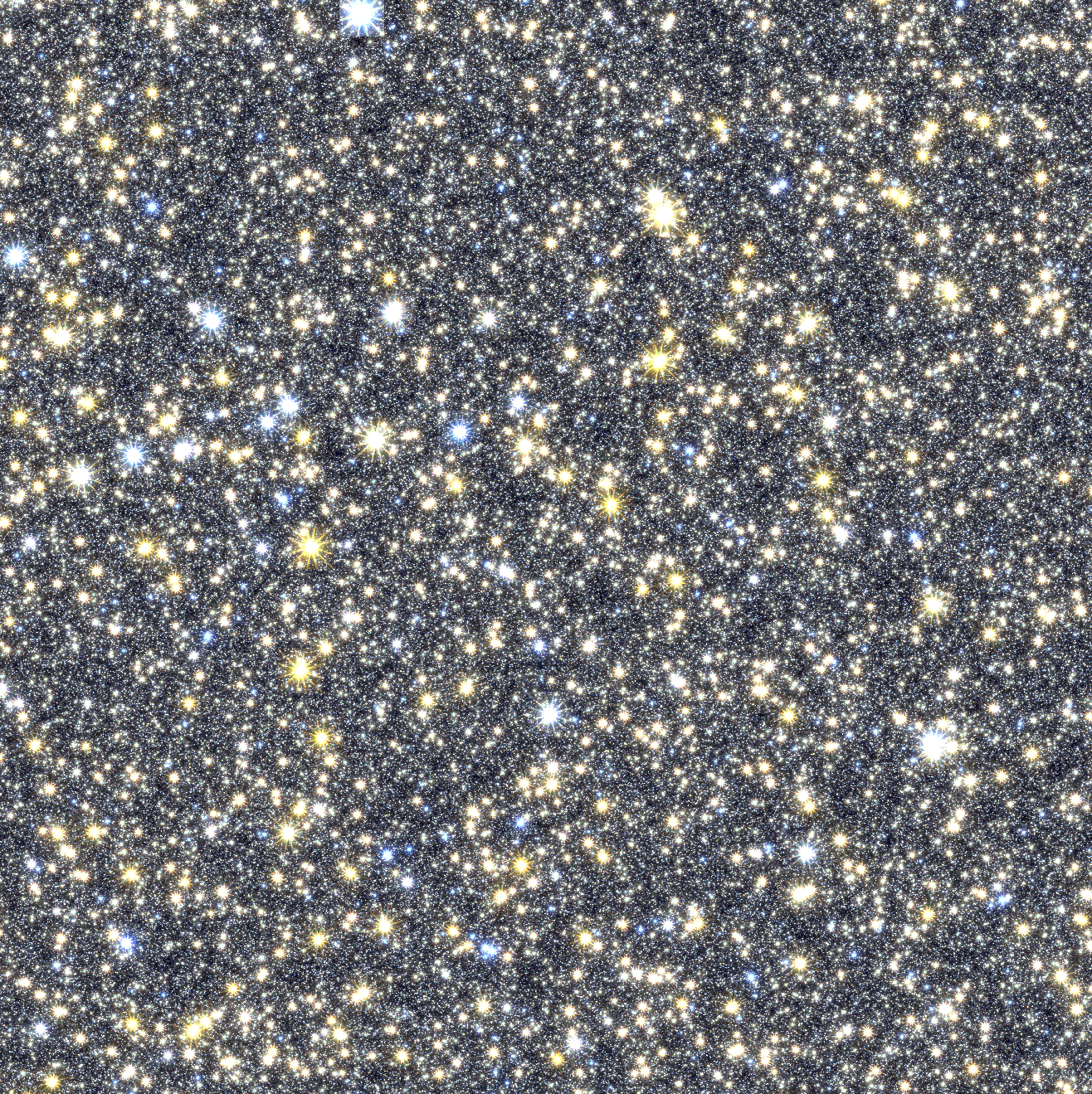
“This is a bit like a preview of the microlensing NASA’s Nancy Grace Roman Space Telescope will do,” said Michael Fausnaugh, a professor at Texas Tech University in Lubbock and a co-author of the study. On track for launch on August 30, 2026, Roman will observe the center of the Milky Way galaxy for one of its core surveys, revealing an estimated 1,000 microlensing planets and around 100,000 transiting planets.
Roman will specifically target the heart of the galaxy because stars are packed so tightly together there, increasing the odds of seeing microlensing events. While that crowding would make many stars blend together in TESS’s larger pixels, TESS looks at nearly the whole sky, where stars are more spread out.
“Since TESS looks elsewhere in the galactic plane, it can naturally find microlensing planets in other parts of the galaxy, as demonstrated by this first microlensing planetary system,” Dragomir said. “That means it could help us study planets in regions with different conditions.”
That could have implications for the search for habitable worlds. The bustling galaxy center is rife with radiation from more frequent supernova explosions, which could sterilize planets. And gravitational encounters between crowded stars may disrupt planetary systems. Observations from TESS focus on a milder part of the galaxy.
“The key to Roman’s microlensing survey is its dense time coverage targeting the galactic bulge,” Fausnaugh said. “The TESS mission uniquely provides these rapid observations for stars in other parts of the galaxy, and pairing the two opens up prospects for understanding planet formation in a diverse population of stars. Since microlensing finds solar system-like planets, this offers a new chance to understand how planetary systems like our own vary in different regions of the galaxy.”
To learn more about the TESS mission, visit:
Media contact:
Claire Andreoli
NASA’s Goddard Space Flight Center, Greenbelt, Md.
301-286-1940
About the Author  Ashley Balzer Ashley is the lead science writer for NASA’s Nancy Grace Roman Space Telescope.
Details Last Updated Jul 01, 2026 Editor Ashley Balzer Contact Ashley Balzer ashley.m.balzer@nasa.gov Location Goddard Space Flight Center Related Terms TESS (Transiting Exoplanet Survey Satellite) Exoplanets Goddard Space Flight Center The Universe
 9 min read Citizen Scientists Spot Jupiter-like Planet in NASA TESS Data
Article
4 years ago
 3 min read NASA’s Planet-Hunting TESS Reveals Dazzling Night Sky NASA’s TESS has released its most complete view of the starry sky to date
Article
2 months ago
 7 min read Journey to Center of Milky Way With Upcoming NASA Roman Core Survey At the heart of our own galaxy, there is a dense thicket of stars with…
Article
5 months ago
 6 min read Why NASA’s Roman Mission Will Study Milky Way’s Flickering Lights NASA’s Nancy Grace Roman Space Telescope will provide one of the deepest-ever views into the…
Article
3 years ago
 5 min read NASA’s TESS Finds Intriguing World Sized Between Earth, Venus
Article
2 years ago
Keep Exploring Discover More Topics From NASA Missions