
6 min read
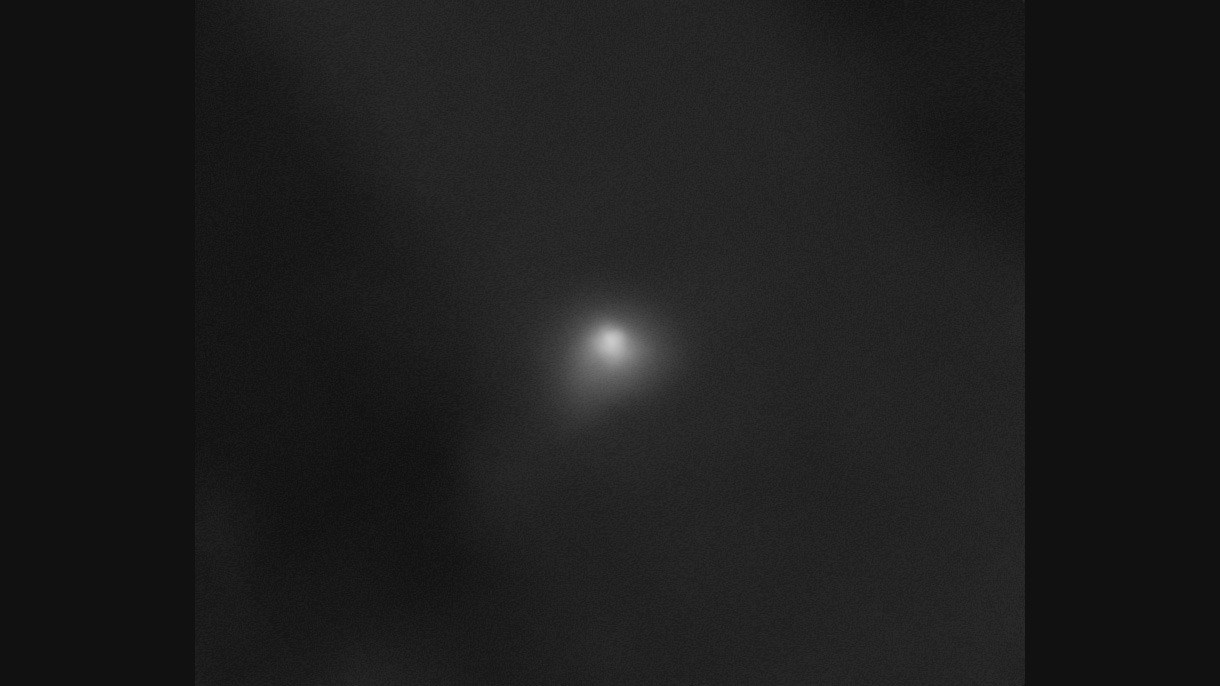
Preparations for Next Moonwalk Simulations Underway (and Underwater)  The High-Resolution Imaging Science Experiment (HiRISE) camera aboard NASA’s Mars Reconnaissance Orbiter captured this image of interstellar comet 3I/ATLAS on Oct. 2, 2025. At the time it was imaged, the comet was about 0.2 astronomical units (18.6 million miles, or 29.9 million kilometers) from the from the spacecraft.NASA/JPL-Caltech/University of ArizonaNASA/JPL-Caltech/University of Arizona
 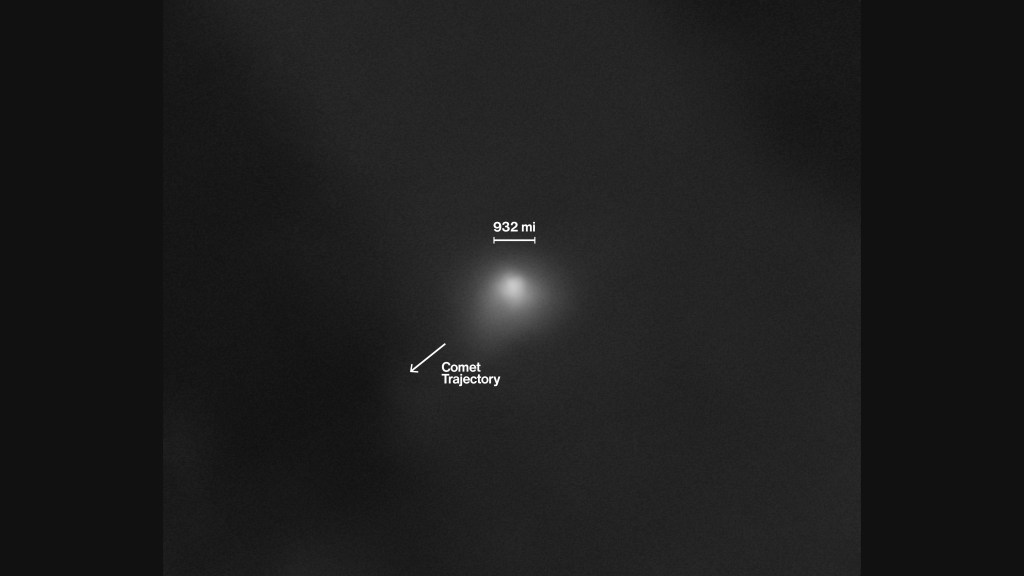 An annotated version of the image of 3I/ATLAS captured by NASA’s Mars Reconnaissance Orbiter shows the trajectory of the interstellar comet along with a scale bar. The image was captured by the spacecraft’s High Resolution Imaging Science Experiment (HiRISE) camera on Oct. 2, 2025.NASA/JPL-Caltech/University of Arizona Two orbiters and a rover captured images of the interstellar object — from the closest location any of the agency’s spacecraft may get — that could reveal new details.
At the start of October, three of NASA’s Mars spacecraft had front row seats to view 3I/ATLAS, only the third interstellar object so far discovered in our solar system. The Mars Reconnaissance Orbiter (MRO) snapped a close-up of the comet, while the MAVEN (Mars Atmosphere and Volatile EvolutioN) orbiter captured ultraviolet images and the Perseverance rover caught a faint glimpse as well.
Imagery from MRO will allow scientists to better estimate the comet’s size, and MAVEN’s images are unique among all observations this year in determining the chemical makeup of the comet and how much water vapor is released as the Sun warms the comet. These details will help scientists better understand the past, present, and future of this object.
HiRISE The comet will be at its closest approach to Earth on Friday, Dec. 19. On Oct. 2, MRO observed 3I/ATLAS from 19 million miles (30 million kilometers) away, with one of the closest views that any NASA spacecraft or Earth-based telescopes are expected to get.
The orbiter’s team viewed the comet with a camera called HiRISE (the High Resolution Imaging Science Experiment), which normally points at the Martian surface. By rotating, MRO can point HiRISE at celestial objects as well — a technique used in 2014, when HiRISE joined MAVEN in studying another comet, called Siding Spring.
Captured at a scale of roughly 19 miles (30 kilometers) per pixel, 3I/ATLAS looks like a pixelated white ball on the HiRISE imagery. That ball is a cloud of dust and ice called the coma, which the comet shed as it continued its trajectory past Mars.
 This ultraviolet image shows the halo of gas and dust, or coma, surrounding comet 3I/ATLAS as seen on Oct. 9, 2025, by NASA’s MAVEN spacecraft using its Imaging Ultraviolet Spectrograph. The brightest pixel at center indicates where the comet is. The surrounding bright pixels show where hydrogen atoms were detected coming from the comet.NASA/Goddard/LASP/CU Boulder
 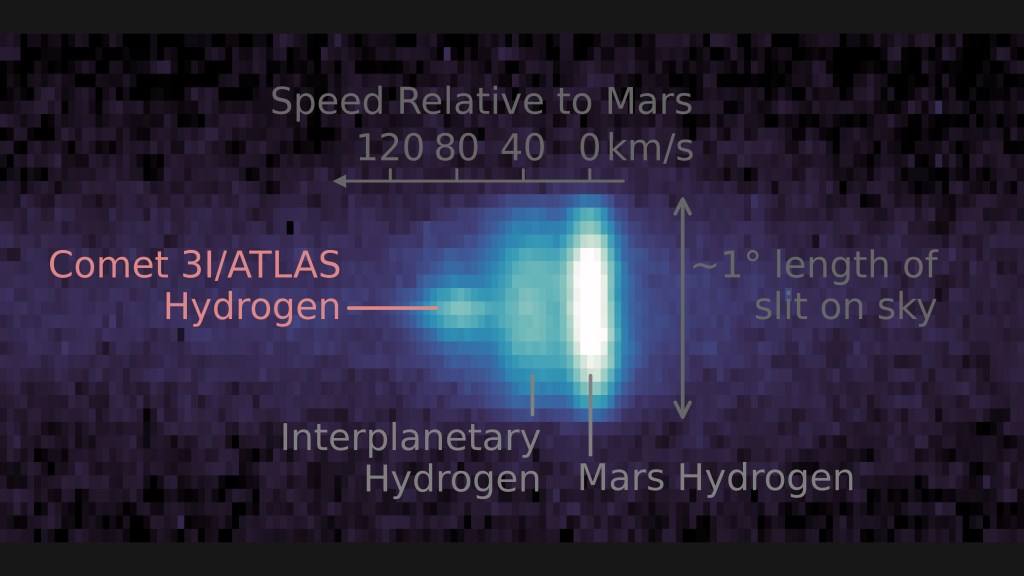 This annotated composite image showing hydrogen atoms from three sources, including 3I/ATLAS (at left), was captured Sept. 28, 2025, by NASA’s MAVEN orbiter using its Imaging Ultraviolet Spectrograph. Hydrogen emitted by Mars is the bright streak at right, with interplanetary hydrogen flowing through the solar system indicated by the dimmer streak in the middle.NASA/Goddard/LASP/CU Boulder “Observations of interstellar objects are still rare enough that we learn something new on every occasion,” said Shane Byrne, HiRISE principal investigator at the University of Arizona in Tucson. “We’re fortunate that 3I/ATLAS passed this close to Mars.”
Further study of the HiRISE imagery could help scientists estimate the size of the comet’s nucleus, its central core of ice and dust. More study also may reveal the size and color of particles within its coma.
“One of MRO’s biggest contributions to NASA’s work on Mars has been watching surface phenomena that only HiRISE can see,” said MRO’s project scientist Leslie Tamppari of NASA’s Jet Propulsion Laboratory in Southern California. “This is one of those occasions where we get to study a passing space object as well.”
Follow 3I/ATLAS’ Journey MAVEN Over the course of 10 days starting Sept. 27, MAVEN captured 3I/ATLAS in two unique ways with its Imaging Ultraviolet Spectrograph (IUVS) camera. First, IUVS took multiple images of the comet in several wavelengths, much like using various filters on a camera. Then it snapped high-resolution UV images to identify the hydrogen coming from 3I/ATLAS. Studying a combination of these images, scientists can identify a variety of molecules and better understand the comet’s composition.
“The images MAVEN captured truly are incredible,” said Shannon Curry, MAVEN’s principal investigator and research scientist at the Laboratory for Atmospheric and Space Physics (LASP) at the University of Colorado Boulder. “The detections we are seeing are significant, and we have only scraped the surface of our analysis.”
The IUVS data also offers an estimated upper limit of the comet’s ratio of deuterium (a heavy isotope of hydrogen) to regular hydrogen, a tracer of the comet’s origin and evolution. When the comet was at its closest to Mars, the team used more sensitive channels of IUVS to map different atoms and molecules in the comet’s coma, such as hydrogen and hydroxyl. Further study of the comet’s chemical makeup could reveal more about its origins and evolution.
“There was a lot of adrenaline when we saw what we’d captured,” said MAVEN’s deputy principal investigator, Justin Deighan, a LASP scientist and the lead on the mission’s comet 3I/ATLAS observations. “Every measurement we make of this comet helps to open up a new understanding of interstellar objects.”
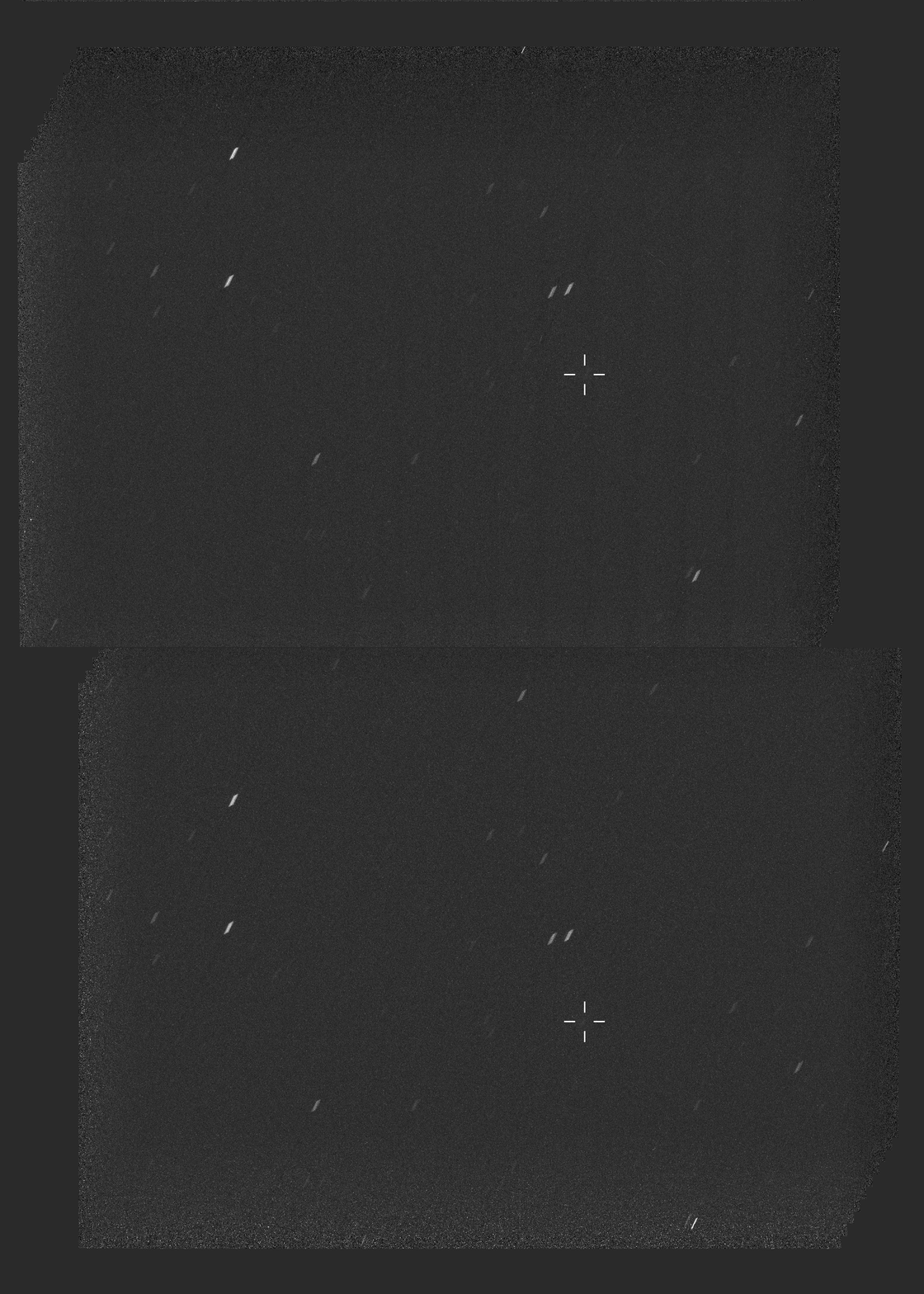 Interstellar comet 3I/ATLAS is seen as a faint smudge against a background starfield in two images taken by the Mastcam-Z instrument aboard NASA’s Perseverance Mars rover on Oct. 4, 2025. At the time it was imaged, the comet was about 19 million miles (30 million kilometers) from the rover, which was exploring the rim of the Red Planet’s Jezero Crater. NASA/JPL-Caltech/ASU/MSSS Perseverance Far below the orbiters, on the Martian surface, NASA’s Perseverance rover also caught sight of 3I/ATLAS. On Oct. 4, the comet appeared as a faint smudge to the rover’s Mastcam-Z camera. The exposure had to be exceptionally long to detect such a faint object. Unlike telescopes that track objects as they move, Mastcam-Z is fixed in place during long exposures. This technique produces star trails that appear as streaks in the sky, though the comet itself is barely perceptible.
More about MRO, MAVEN, Perseverance A division of Caltech in Pasadena, California, JPL manages MRO for NASA’s Science Mission Directorate in Washington as part of NASA’s Mars Exploration Program portfolio. The University of Arizona in Tucson operates MRO’s HiRISE, which was built by BAE Systems in Boulder, Colorado. Lockheed Martin Space in Denver built MRO and supports its operations.
The MAVEN mission, also part of NASA’s Mars Exploration Program portfolio, is led by the Laboratory for Atmospheric and Space Physics at the University of Colorado Boulder. It’s managed by NASA’s Goddard Space Flight Center in Greenbelt, Maryland. MAVEN was built and operated by Lockheed Martin Space in Littleton, Colorado, with navigation and network support from JPL.
JPL built and manages operations of the Perseverance rover on behalf of the agency’s Science Mission Directorate as part of NASA’s Mars Exploration Program portfolio.
To learn more about NASA’s observations of comet 3I/ATLAS, visit:
News Media Contacts
Andrew Good
Jet Propulsion Laboratory, Pasadena, Calif.
818-393-2433
andrew.c.good@jpl.nasa.gov
Alise Fisher / Molly Wasser
NASA Headquarters, Washington
202-617-4977 / 240-419-1732
alise.m.fisher@nasa.gov / molly.l.wasser@nasa.gov
2025-128
 3 min read View Interstellar Comet 3I/ATLAS Through NASA’s Multiple Lenses This article was updated to include the full range of dates from the SOHO image.…
Article 1 hour ago
 4 min read What Would It Take to Say We Found Life? We Asked a NASA Expert: Episode 63 Article 2 months ago
  6 min read NASA Marsquake Data Reveals Lumpy Nature of Red Planet’s Interior Article 3 months ago
 Keep Exploring Discover Related Topics Explore Earth Science From its origins, NASA has studied our planet in novel ways, using a fleet of satellites and ambitious airborne and ground-based…