
3 min read
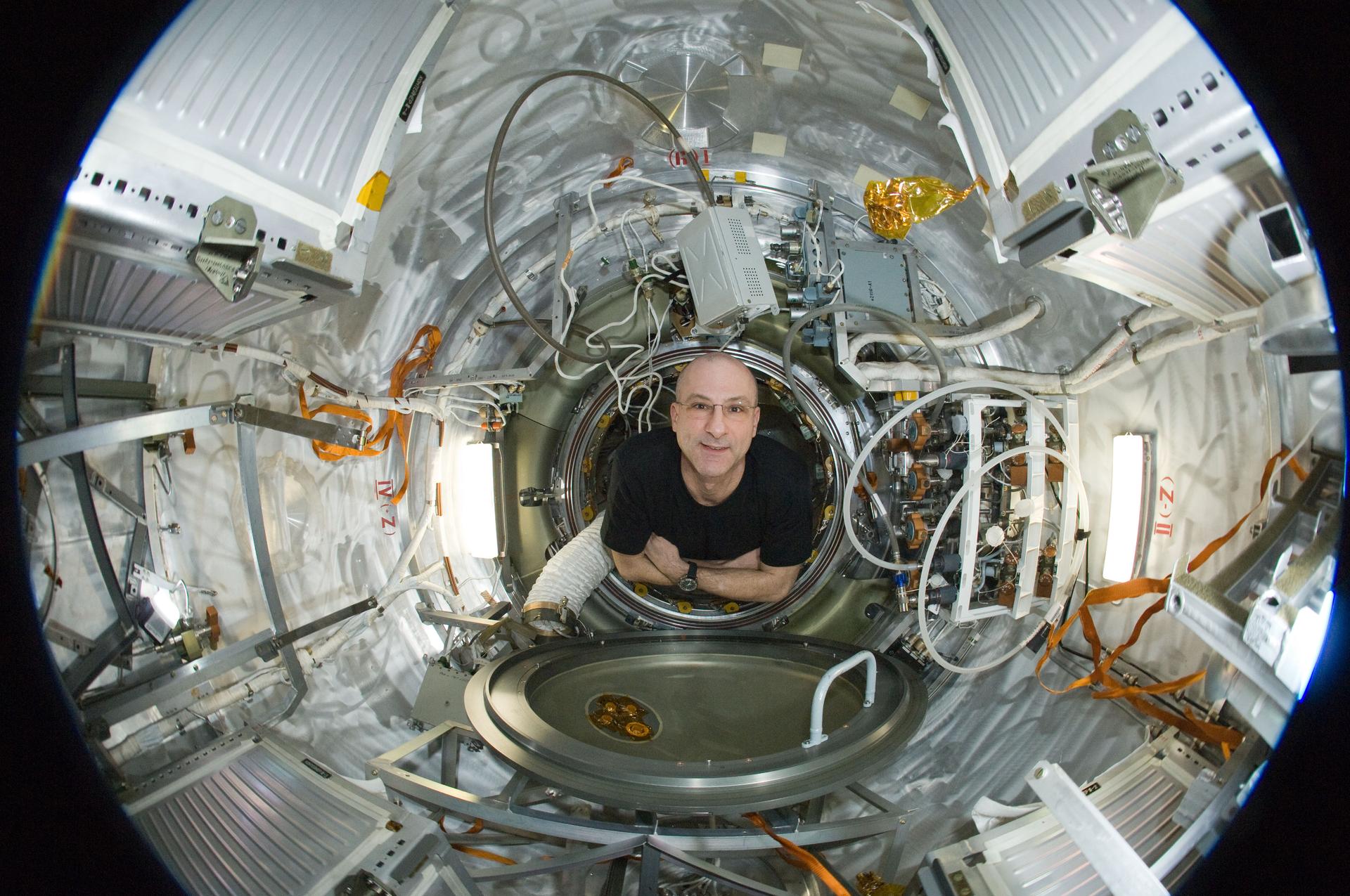
Preparations for Next Moonwalk Simulations Underway (and Underwater)  A fisheye lens attached to an electronic still camera was used to capture this image of NASA astronaut Don Pettit.NASA Science ideas are everywhere. Some of the greatest discoveries have come from tinkering and toying with new concepts and ideas. NASA astronaut Don Pettit is no stranger to inventing and discovering. During his previous missions, Pettit has contributed to advancements for human space exploration aboard the International Space Station resulting in several published scientific papers and breakthroughs.
Pettit, accompanied by cosmonauts Alexey Ovchinin and Ivan Vagner, will launch to the orbiting laboratory in September 2024. In preparation for his fourth spaceflight, read about previous “science of opportunity” experiments Pettit performed during his free time with materials readily available to the crew or included in his personal kit.
Freezing Ice in Space  Thin ice under polarized light frozen aboard the International Space Station.NASA Have you ever noticed a white bubble inside the ice in your ice tray at home? This is trapped air that accumulates in one area due to gravity. Pettit took this knowledge, access to a -90° Celsius freezer aboard the space station, and an open weekend to figure out how water freezes in microgravity compared to on Earth. This photo uses polarized light to show thin frozen water and the visible differences from the ice we typically freeze here on Earth, providing more insight into physics concepts in microgravity.
Space Cup  NASA astronaut Don Pettit demonstrates how surface tension, wetting, and container shape hold coffee in the space cup.NASA Microgravity affects even the most mundane tasks, like sipping your morning tea. Typically, crews drink beverages from a specially sealed bag with a straw. Using an overhead transparency film, Pettit invented the prototype of the Capillary Beverage, or Space Cup. The cup uses surface tension, wetting, and container shape to mimic the role of gravity in drinking on Earth, making drinking beverages in space easier to consume and showing how discoveries aboard station can be used to design new systems.
Planetary Formation To view this video please enable JavaScript, and consider upgrading to a web browser that supports HTML5 video
Astronaut Don Pettit demonstrates a mixture of coffee grounds and sugar sticking together in microgravity to understand planetary formation. NASA Using materials that break into very small particles, such as table salt, sugar, and coffee, Pettit experimented to understand planetary formation. A crucial early step in planet formation is the aggregation or clumping of tiny particles, but scientists do not fully understand this process. Pettit placed different particulate mixtures in plastic bags, filled them with air, thoroughly shook the bags, and observed that the particles clumped within seconds due to what appears to be an electrostatic process. Studying the behavior of tiny particles in microgravity may provide valuable insight into how material composition, density, and turbulence play a role in planetary formation.
Orbital Motion  Charged water particles orbit a knitting needle, showing electrostatic processes in space. NASA Knitting needles made of different materials arrived aboard station as personal crew items. Pettit electrically charged the needles by rubbing each one with paper. Then, he released charged water from a Teflon syringe and observed the water droplets orbit the knitting needle, demonstrating electrostatic orbits in microgravity. The study was later repeated in a simulation that included atmospheric drag, and the 3D motion accurately matched the orbits seen in the space station demonstration. These observations could be analogous to the behavior of charged particles in Earth’s magnetic field and prove useful in designing future spacecraft systems.
Astrophotography  Top: NASA astronaut Don Pettit photographed in the International Space Station cupola surrounded by cameras. Bottom: Star trails photographed by NASA astronaut Don Pettit in March of 2012.NASA An innovative photographer, Pettit has used time exposure, multiple cameras, infrared, and other techniques to contribute breathtaking images of Earth and star trails from the space station’s unique viewpoint. These photos contribute to a database researchers use to understand Earth’s changing landscapes, and this imagery can inspire the public’s interest in human spaceflight.
Christine Giraldo
International Space Station Research Communications Team
Keep Exploring Discover More Topics Missions



