
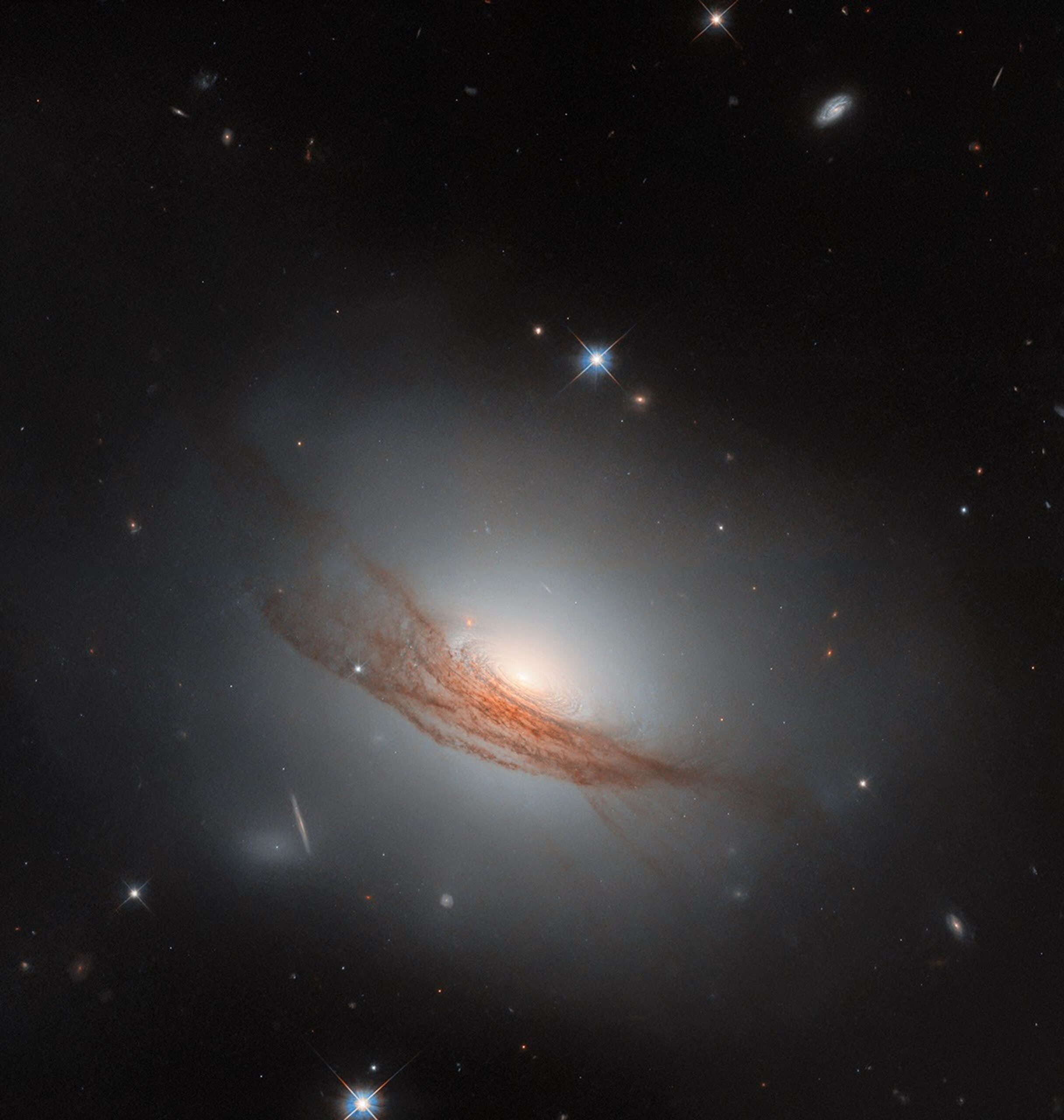
 This NASA/ESA Hubble Space Telescope image of NGC 7722, a lenticular galaxy located about 187 million light-years away, features concentric rings of dust and gas that appear to swirl around its bright nucleus.ESA/Hubble & NASA, R. J. Foley (UC Santa Cruz), Dark Energy Survey/DOE/FNAL/DECam/CTIO/NOIRLab/NSF/AURA; Acknowledgment: Mehmet Yüksek This new Hubble image, released on Jan. 30, 2026, is the sharpest taken of NGC 7722, a lenticular galaxy located about 187 million light-years away in the constellation Pegasus. A lenticular, meaning “lens-shaped,” galaxy is a type whose classification sits between more familiar spiral galaxies and elliptical galaxies. It is also less common than spirals and ellipticals — partly because these galaxies have a somewhat ambiguous appearance, making it hard to determine if it is a spiral, an elliptical, or something in between.
Learn more about this observation.
Image credit: ESA/Hubble & NASA, R. J. Foley (UC Santa Cruz), Dark Energy Survey/DOE/FNAL/DECam/CTIO/NOIRLab/NSF/AURA; Acknowledgment: Mehmet Yüksek