
DNA-inspired therapies and space agriculture topped the research schedule aboard the International Space Station on Thursday. The Expedition 74 crew members also serviced a variety of lab hardware including a quantum physics facility, a spacesuit, and life support gear throughout their busy day.
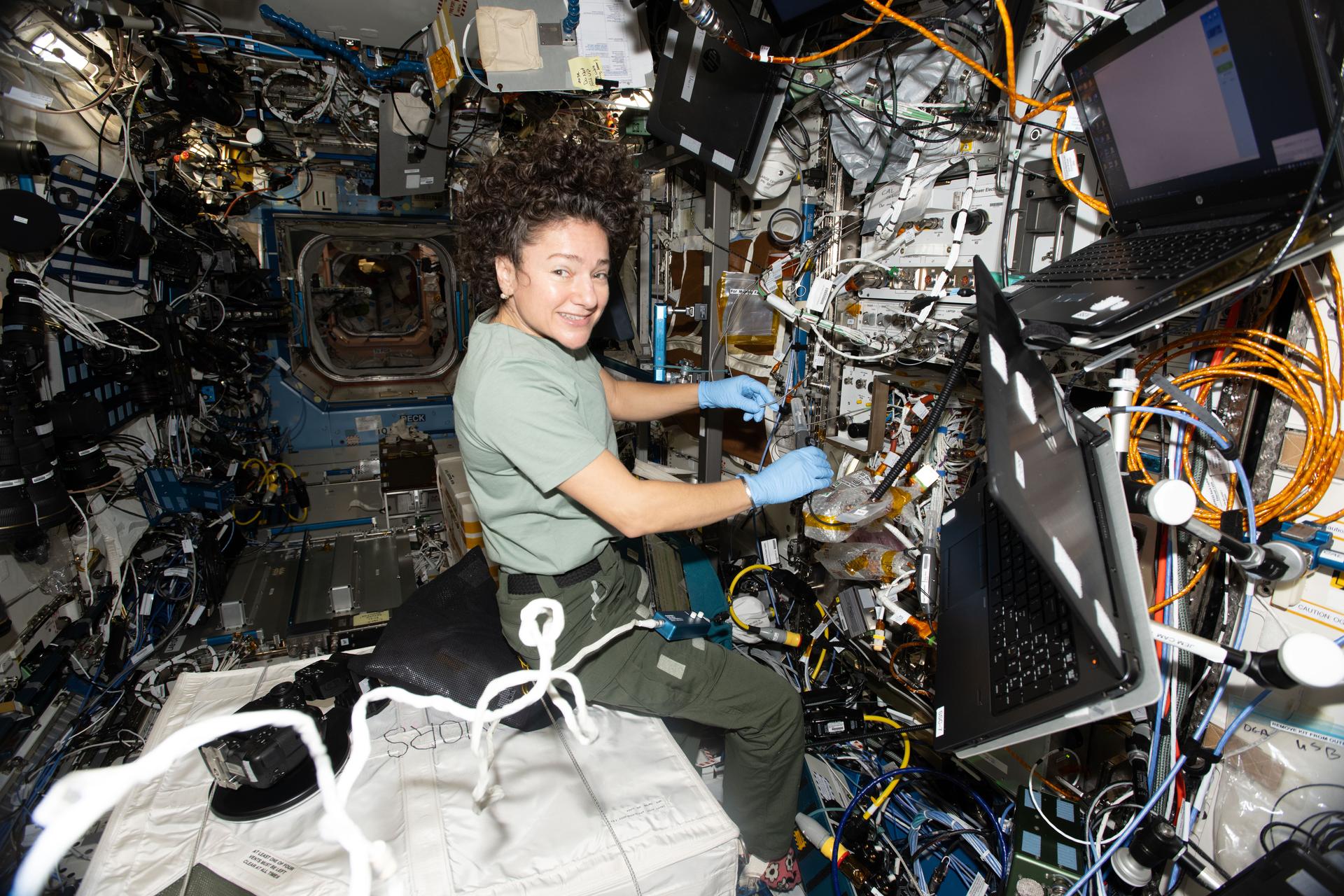
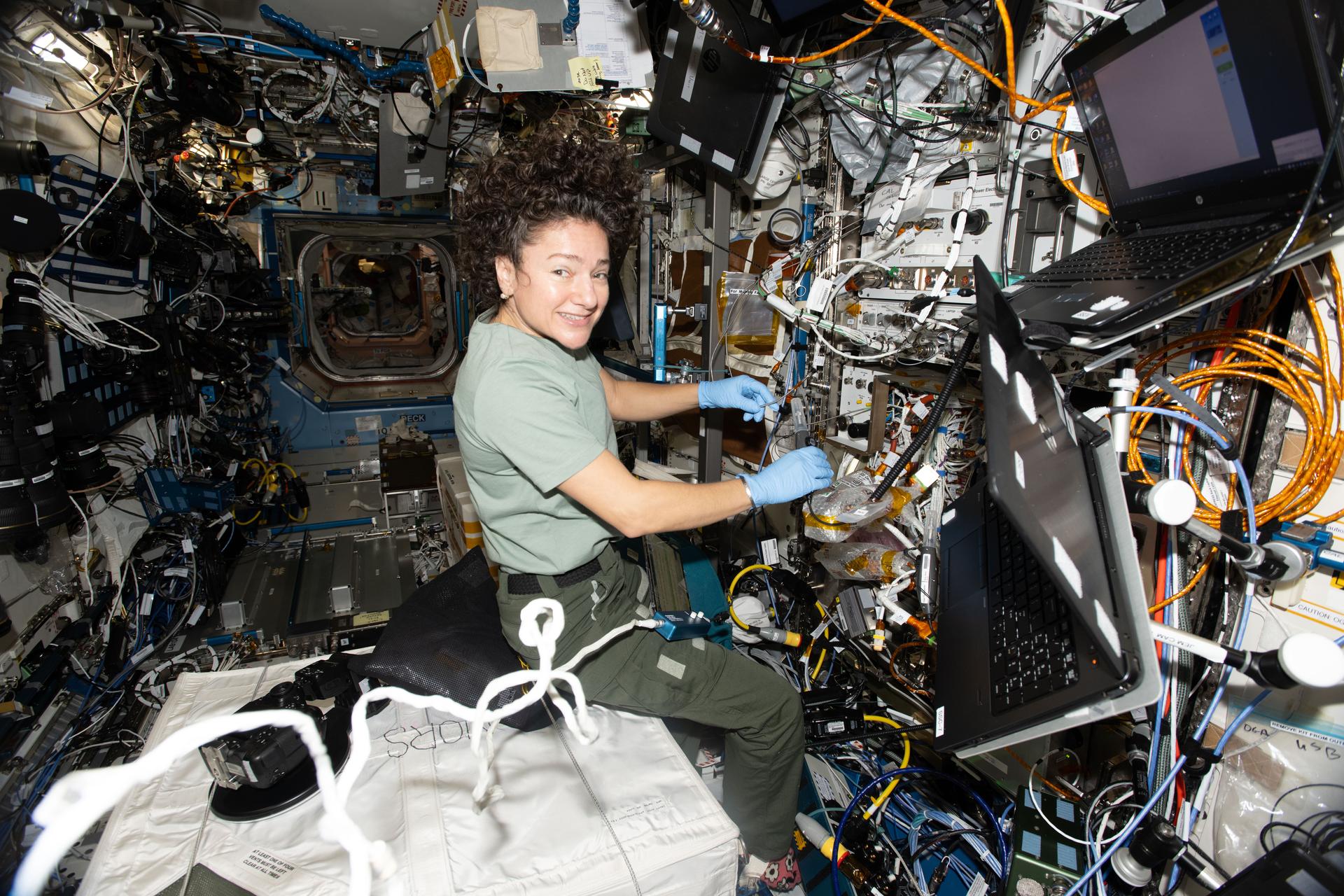
NASA flight engineer Jessica Meir worked in the Harmony module on a biotechnology investigation to observe how tiny, engineered materials that mimic DNA behave in microgravity. Meir pointed a light-measuring device, called a spectrophotometer, at the DNA-like sample materials housed in small transparent containers to analyze their ability to form stable structures. Next, she transferred the research data to a computer so doctors can downlink the information and learn how to improve and develop future treatments, or nano-therapies, that target cancer cells more precisely.
Flight engineer Sophie Adenot of ESA (European Space Agency) watered alfalfa plants growing inside the Columbus laboratory module’s Veggie botany research facility for the Veg-06 plant-microbe study. The experiment is exploring how plants source nitrogen and thrive in microgravity to promote food production in space during long term missions. Afterward, Adenot had her eye pressure checked by Meir who used a tonometer, an optometry tool that measures fluid pressure in the eye. Doctors regularly examine an astronaut’s eyes to detect and counteract potential space-caused vision conditions.
NASA flight engineer Jack Hathaway began his shift inside the Destiny laboratory module servicing a cooling unit inside the Cold Atom Lab (CAL) quantum research device. CAL chills atoms to near absolute zero trapping them for observation providing insights into atomic wave functions, general relativity, and dark matter. The CAL received a new quantum physics module, expanding the capacity of the research device, on April 13 when Northrop Grumman’s Cygnus XL cargo spacecraft arrived at the station. Hathaway ended his shift in the Quest airlock swapping components on a spacesuit for return to Earth.
NASA flight engineer Chris Williams was back inside the Kibo laboratory module continuing to remove research hardware for packing inside a SpaceX Dragon cargo spacecraft due to arrive next week. Williams later rearranged cargo inside the Cygnus XL spacecraft then took off the sensor-packed Bio-Monitor vest and headband that he wore for two days of health data collection.
Station commander Sergey Kud-Sverchkov and flight engineer Sergei Mikaev began their shift taking turns wearing an acoustic sensor around their necks and recording their rapid exhalation to understand how microgravity affects the respiratory system. The Roscosmos duo then partnered together the rest of the day unloading cargo packed inside the Progress 95 resupply ship.
Roscosmos flight engineer Andrey Fedyaev spent his shift continuing to replace hoses, connectors, and valves that carry water removed from the station’s air by the Zvezda service module’s dehumidifiers.
Learn more about station activities by following the space station blog, @space_stationon X, as well as the ISS Facebookand ISS Instagram accounts.
Get the latest from NASA delivered every week. Subscribe here.