
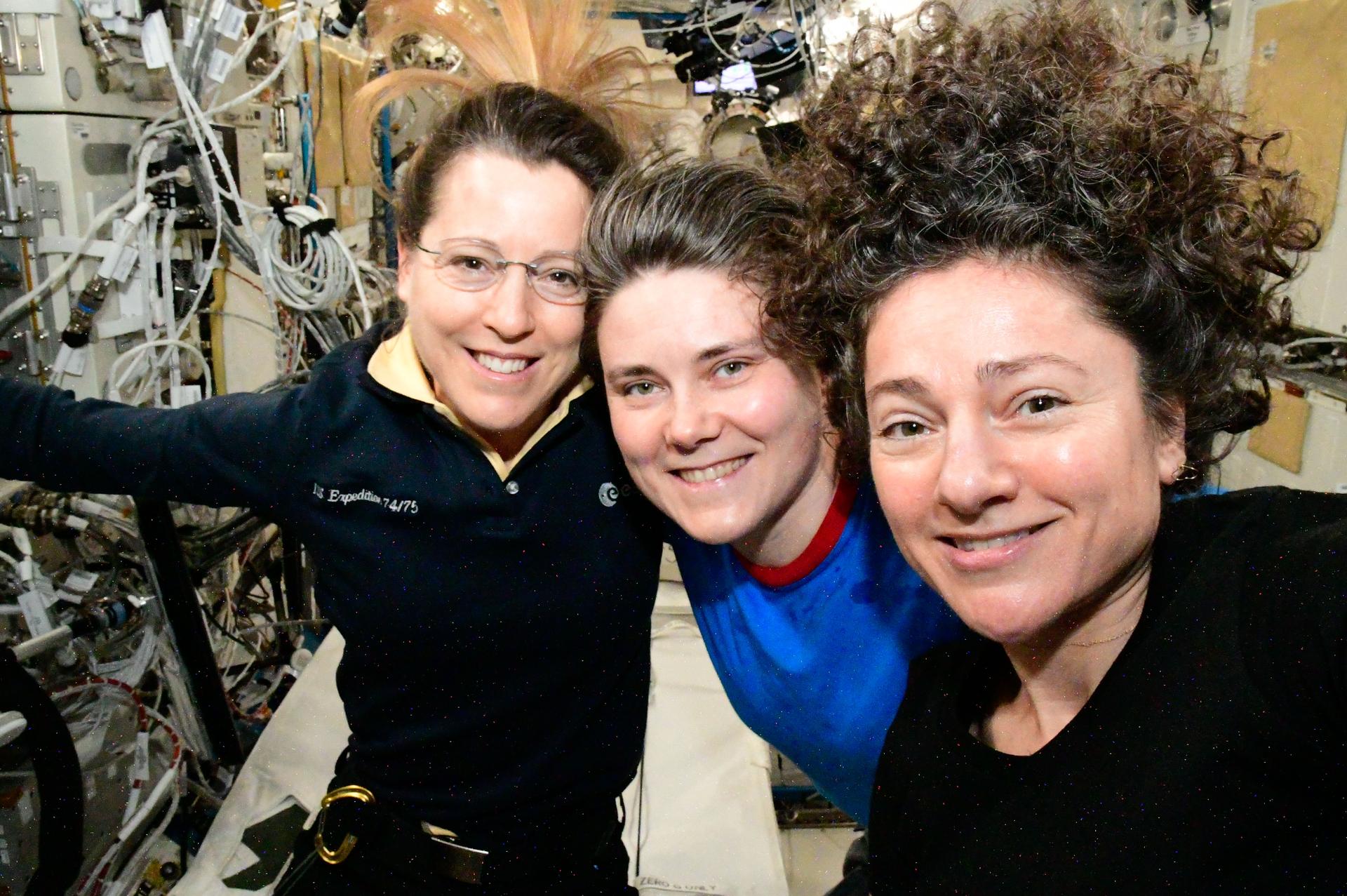
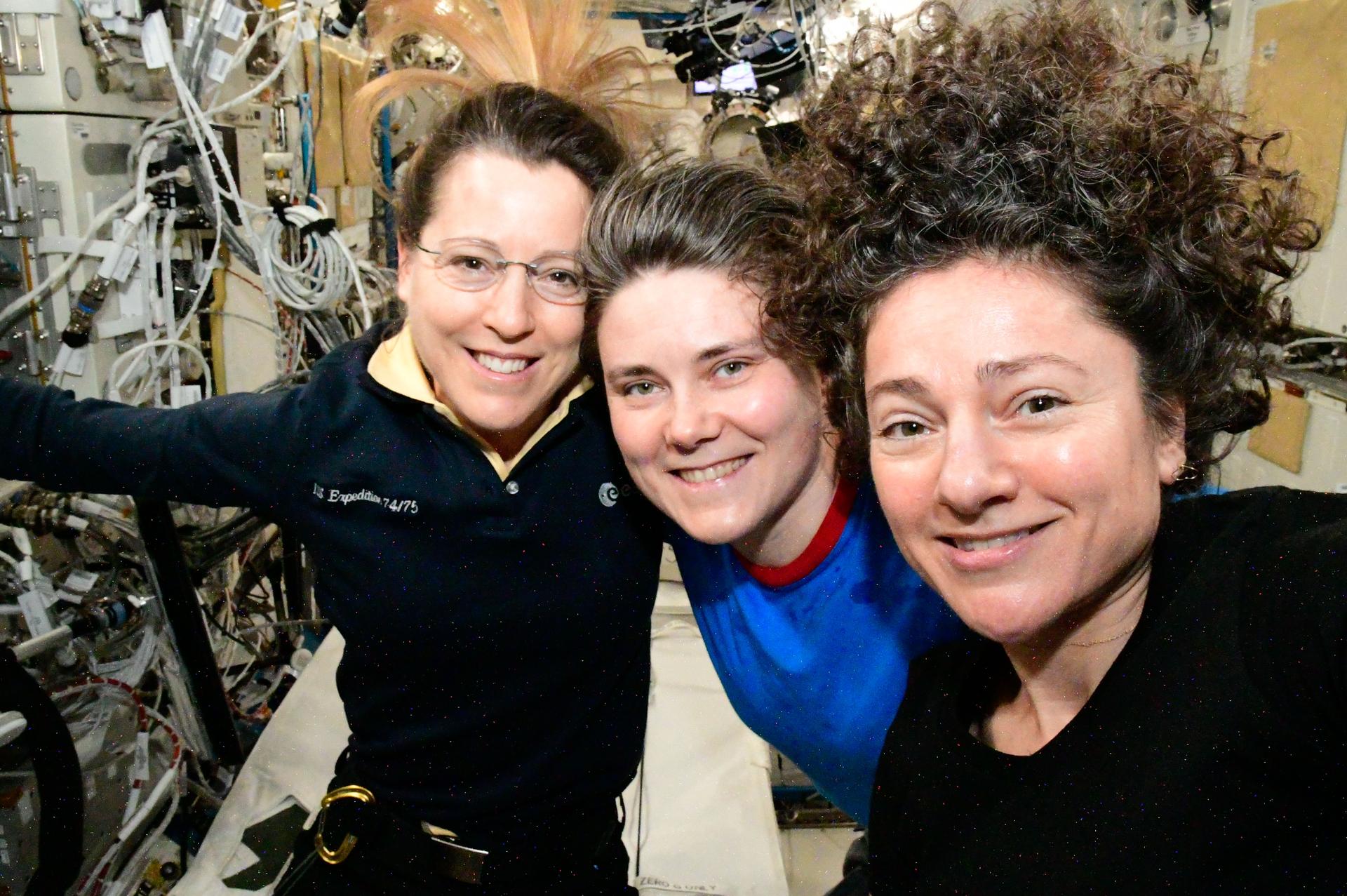
Circuit board soldering, spacesuit maintenance, and cargo mission operations topped the schedule for the Expedition 75 crew aboard the International Space Station on Thursday. The orbital residents also worked on cardiac research, virtual reality tests, and housekeeping tasks throughout the day.
Longer space missions farther away from Earth will require crews to be more self-sufficient and less dependent on cargo missions and ground support. As a result, NASA flight engineer Anil Menon has been working on the MIYOKA experiment this week to demonstrate the safe manufacturing and repairing of electronics in microgravity. Menon has been using a lead-free soldering technique to solder components on a circuit board that will be returned to Earth and compared to identical ground-soldered samples. Results may inform future crews travelling to the Moon, Mars, and beyond reducing reliance on costly resupply missions.
Spacesuits have been occupying the crew following a busy period of four spacewalks that took place over a monthlong period. Station commander Jessica Meir and flight engineer Jack Hathaway of NASA took turns in the Quest airlock cleaning, inspecting, and checking the functionality of spacesuit cooling systems to ensure their readiness for future spacewalks. Meir commented about her most recent spacewalk when she rode the Canadarm2 robotic arm on Sept. 1 during a news conference on Wednesday, “I felt like I was just there levitating above the Earth. I think that was the biggest eureka moment for me.”
Hathaway also joined up with flight engineer Sophie Adenot of ESA (European Space Agency) in the cupola, configuring cleaning tools, and preparing its seven windows overlooking the Earth for an upcoming deep-cleaning session. Adenot began her shift listening to a relaxing narrative then filling out a questionnaire, both on a computer tablet, for the RelaxPro investigation that seeks to reduce stress and improve sleep for astronauts. She wrapped up her shift exercising on the Tranquility module’s advanced resistive exercise device as experts on the ground monitored in real time to learn how to improve workouts in weightlessness.
Roscosmos flight engineers Pyotr Dubrov and Anna Kikina are preparing for the arrival of 2.8 tons of food, fuel, and supplies packed aboard the Progress 96 cargo spacecraft that launched from Kazakhstan on Wednesday. Dubrov and Kikina tested the Zvezda service module’s tele-operated robotic unit, or TORU, in advance of Progress 96 docking automatically to the Poisk module at 9:46 a.m. EDT on Saturday. The TORU would be used to remotely control a Roscosmos spacecraft in the unlikely event its automated rendezvous and docking system failed.
The cosmonaut pair also took turns wearing arm, wrist, and finger cuffs measuring their blood pressure to document microgravity’s effect on the microcirculatory system. Finally, the duo wore virtual reality headsets and a special body-worn control device to simulate manipulating robots aboard the space station for the Teledroid investigation.
Roscosmos flight engineer Andrey Fedyaev spent his shift servicing laptop computers in the Nauka science module and transferring water between tanks in Zvezda.
Learn more about station activities by following the space station blog, @space_station on X, as well as the ISS Facebook and ISS Instagram accounts.
Get the latest from NASA delivered every week. Subscribe here.