
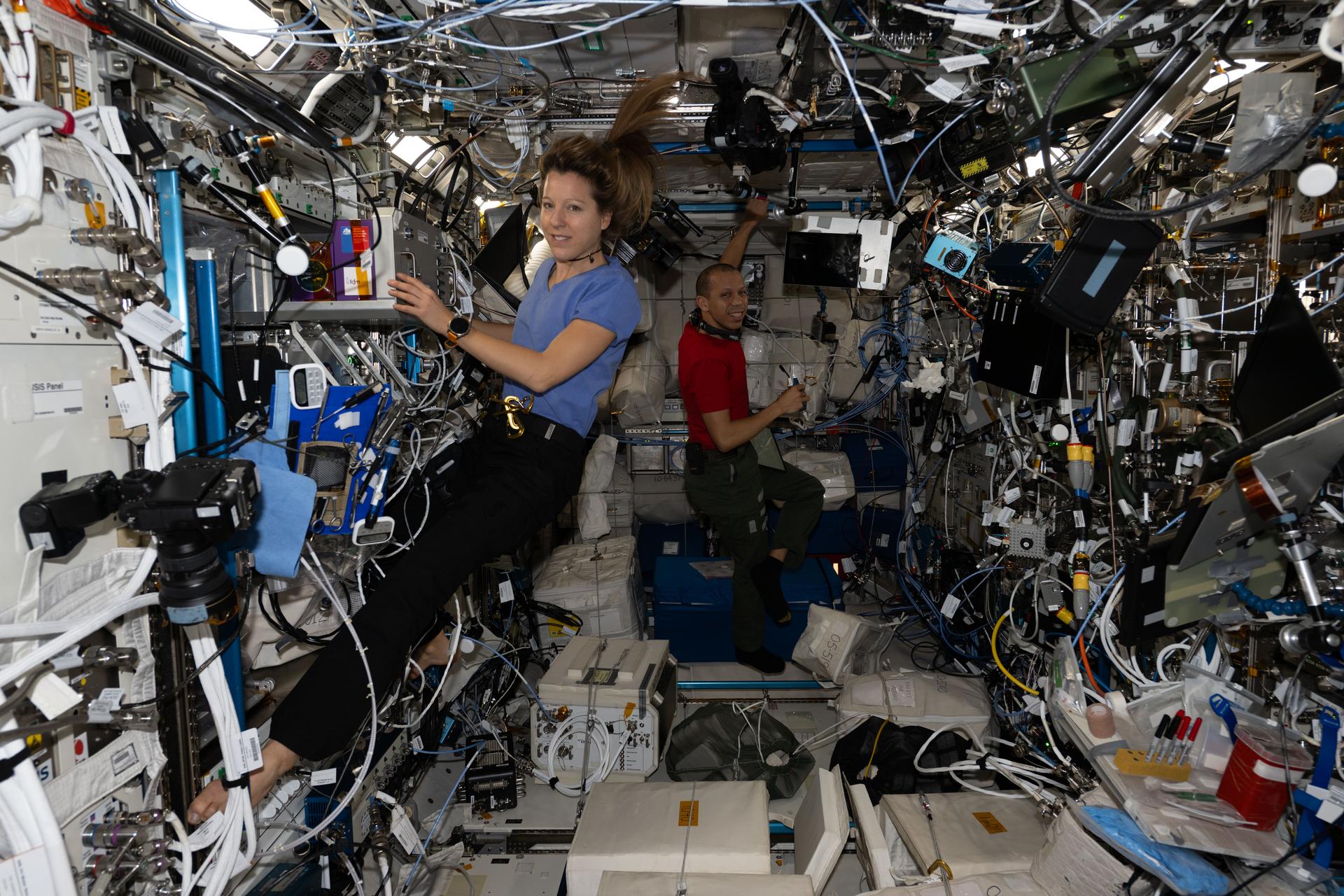
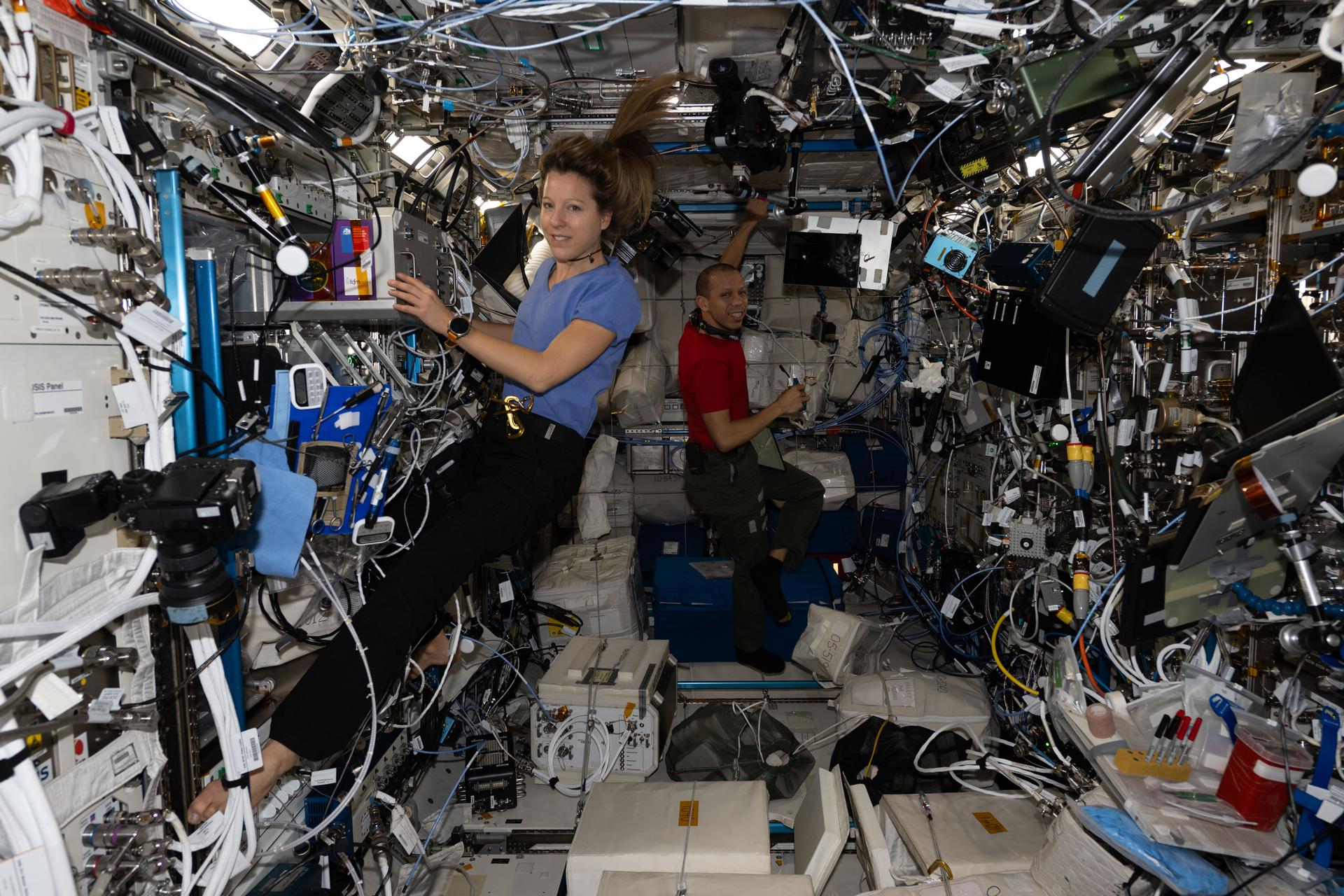
Biotechnology research seeking to advance human health and the space economy packed the science schedule aboard the International Space Station on Tuesday. The Expedition 74 crew members also explored space physics, updated robotics software, and conducted an emergency drill.
Blood stem cells and DNA-inspired nanomaterials were the dominant research themes aboard the orbital outpost as the lab residents helped doctors on the ground explore new methods to treat space-caused ailments and Earthbound illnesses. The new experiments were delivered aboard Northrop Grumman’s Cygnus XL cargo spacecraft on April 13 then installed and activated inside the space station shortly afterward.
Flight engineers Sophie Adenot of ESA (European Space Agency) and Jack Hathaway of NASA partnered together on Tuesday processing blood stem cell samples to learn how to manufacture greater numbers of clinical grade stem cells in space. Results may lead to enhanced stem cell attributes potentially leading to improved blood disease and cancer therapies and expanding space commerce opportunities. Hathaway also powered up the KERMIT fluorescent microscope in the Destiny laboratory module so scientists on the ground could remotely view how microgravity affects the blood stem cells.
Afterward, the duo joined NASA flight engineers Jessica Meir and Chris Williams and set up the DNA Nano Therapeutics-3 experiment inside the Kibo laboratory module’s Life Science Glovebox. The biotechnology study explores mimicking DNA-assembly to manufacture nano-therapies in microgravity potentially improving patient treatments on Earth and benefitting the space economy.
Meir later configured and powered on the Canadian Space Agency’s Bio-Analyzer then tested the research device that analyzes the molecular and cellular properties of a variety of biological samples. Next, she injected gas into experiment hardware installed inside Destiny’s Microgravity Science Glovebox for a physics study exploring long-term storage methods of cryogenic fluids for spacecraft fuel and life support systems.
Williams began his shift with station commander Sergey Kud-Sverchkov and flight engineer Sergei Mikaev, both Roscosmos cosmonauts, practicing an emergency departure drill inside the Soyuz MS-28 spacecraft. The trio trained for the evacuation procedure on a descent simulator as Roscosmos mission controllers on the ground monitored in real time.
Afterward, Kud-Sverchkov jogged on the Zvezda service module’s treadmill while attached to sensors measuring his cardiac activity for a regularly scheduled fitness test. Mikaev filled out a questionnaire helping researchers understand how international crews work together potentially leading to improved training techniques.
Roscosmos flight engineer Andrey Fedyaev worked inside the Nauka science module installing new software on a laptop computer for improved control of the European robotic arm. The two-time space station resident also worked throughout Tuesday maintaining plumbing and ventilation systems throughout the orbiting lab’s Roscosmos segment.
Learn more about station activities by following the space station blog, @space_station on X, as well as the ISS Facebook and ISS Instagram accounts.
Get the latest from NASA delivered every week. Subscribe here.