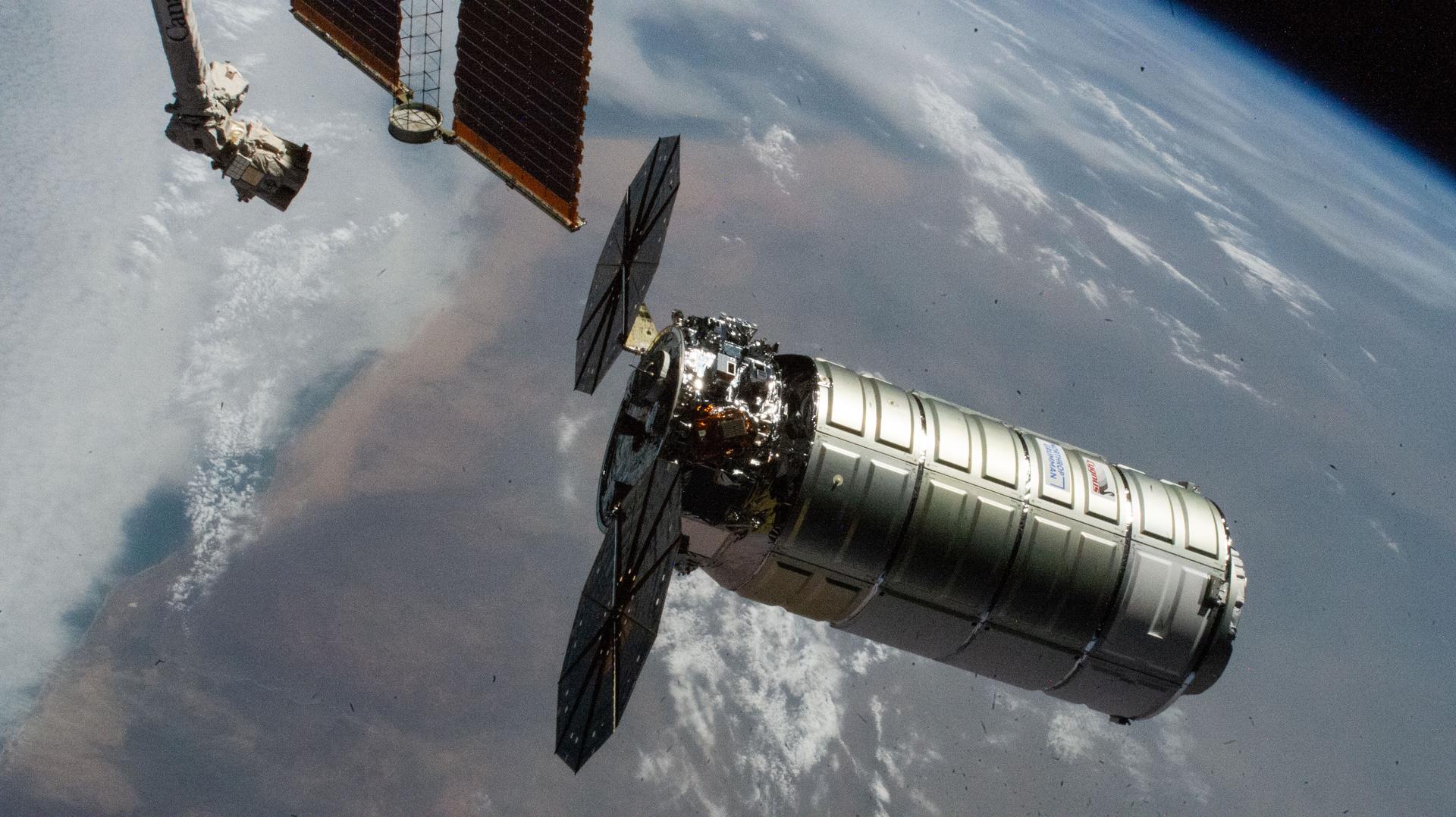
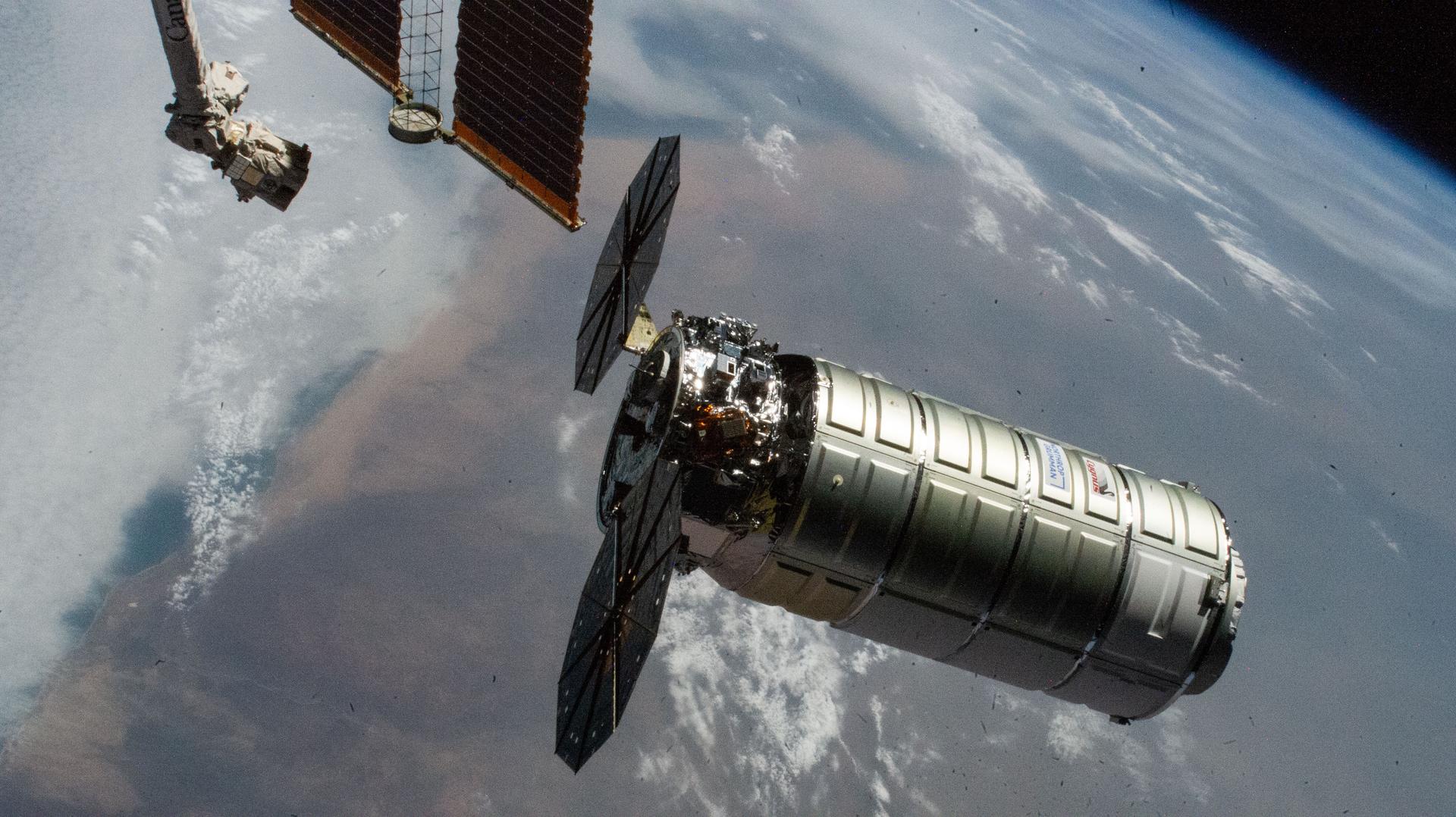
Northrop Grumman’s Cygnus XL cargo spacecraft sits atop a SpaceX Falcon 9 rocket counting down to a launch targeted at 7:41 a.m. EDT on Saturday to resupply the Expedition 74 crew. Packed with over 11,000 pounds of lab hardware, science experiments, and crew supplies, Cygnus XL is due to arrive at the International Space Station where it will be captured with the Candarm2 robotic arm on Monday.
NASA flight engineers Chris Williams and Jack Hathaway joined each other in the cupola on Friday and practiced capturing Cygnus XL during a computer simulation using the robotics workstation. Williams and Hathaway trained to use the workstation’s control panel and hand controllers to maneuver the Canadarm2. The duo watched camera views simulating the Cygnus XL approaching the station and prepared for different capture scenarios.
Williams will be at the controls of the robotics workstation on Monday maneuvering the Canadarm2 to capture Cygnus XL while Hathaway monitors the spacecraft’s approach and rendezvous. Following its capture, mission controllers will take over and remotely command the Canadarm2 to install Cygnus XL to the Unity module’s Earth-facing port where it will stay for a six-month mission.
Watch the agency’s Cygnus XL launch and arrival coverage on NASA+, Amazon Prime, and the agency’s YouTube channel. Learn how to watch NASA content through a variety of platforms, including social media.
Afterward, Williams and Hathaway gathered together with flight engineers Jessica Meir of NASA and Sophie Adenot of ESA (European Space Agency) and called down to mission controllers to discuss cargo operations after the hatches are opened on Cygnus XL. Inside the resupply ship will be a host of new science experiments including a quantum physics module to expand the abilities of the Cold Atom Lab, a blood stem cell study to treat cancers and blood disorders, an investigation to protect astronaut gut health, and more.
In the Roscosmos segment of the orbital outpost, station commander Sergey Kud-Sverchkov and flight engineer Sergei Mikaev took turns wearing an acoustic sensor around their necks and recorded their rapid exhalation to understand how microgravity affects the respiratory system. Flight engineer Andrey Fedyaev continued testing artificial intelligence tools to improve space crew operations and communications.
Learn more about station activities by following the space station blog, @space_station on X, as well as the ISS Facebook and ISS Instagram accounts.
Get the latest from NASA delivered every week. Subscribe here.