
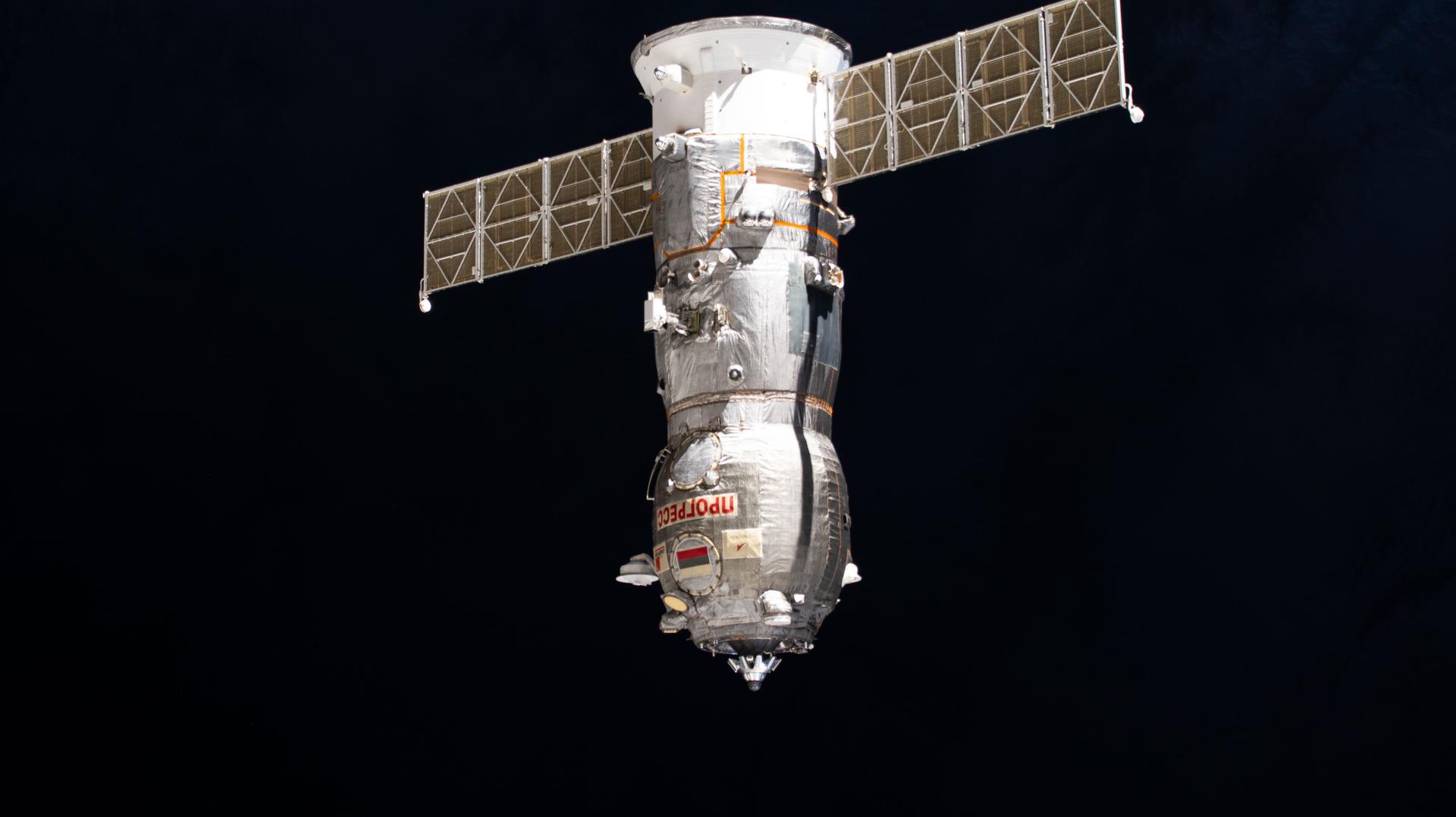
A Progress 95 cargo craft is orbiting Earth on its way to resupply the Expedition 74 with about three tons of food, fuel, and supplies. Two cosmonauts will be on duty monitoring the Progress 95 when it automatically docks to the International Space Station rear port on the Zvezda service module at 8 p.m. EDT on Monday.
Station commander Sergey Kud-Sverchkov and flight engineer Sergei Mikaev, both from Roscosmos, called down to mission controllers on Monday for a final cargo mission preparation conference. They will be inside Zvezda tracking Progress 95 during its automated approach and rendezvous with the orbital outpost. The duo also later took turns wearing a virtual reality headset for a study observing how a crew member’s balance and orientation adjusts in weightlessness.
Eye checks and vein scans were also on the schedule Monday helping doctors continuously assess crew health during a long-term spaceflight. NASA flight engineer Jessica Meir led a pair of eye tests examining NASA flight engineer Chris Williams’ retinas. She first attached electrodes around Williams’ eyes and used electroretinography to stimulate his retinas using flashes or patterns of light. For the second test, Williams’ peered into medical imaging hardware operated by Meir to scan his retinas. Doctors on the ground remotely assisted the eye checks to gain insight into how microgravity affects vision and the eye’s physical condition.
Earlier, NASA flight engineer Jack Hathaway scanned the neck, shoulder, and leg veins of Meir using the Ultrasound 3 biomedical device and collected her blood pressure measurements. Flight surgeons constantly monitor a crew member’s circulatory system to reduce the risk of space-caused blood clots—also called thrombosis.
Flight engineer Sophie Adenot of ESA (European Space Agency) explored using the space station’s potable water to produce medical grade intravenous fluids, or saline solutions, to treat medical conditions in space. The Intravenous Fluid Generation – Mini technology demonstration seeks to reduce a crew’s dependence on cargo missions and avoid expiration of medical supplies on a spacecraft.
Roscosmos flight engineer Andrey Fedyaev started his shift replacing orbital plumbing components in the Nauka science module that separate air from water. Next, Fedyaev took part in another blood pressure study wearing a series of cuffs on his arm, wrist, and thumb. Doctors collected the cardiac data to understand how living in space affects blood flow regulation, clot prevention, and inflammation responses.
Learn more about station activities by following the space station blog, @space_station on X, as well as the ISS Facebook and ISS Instagram accounts.
Get the latest from NASA delivered every week. Subscribe here.