
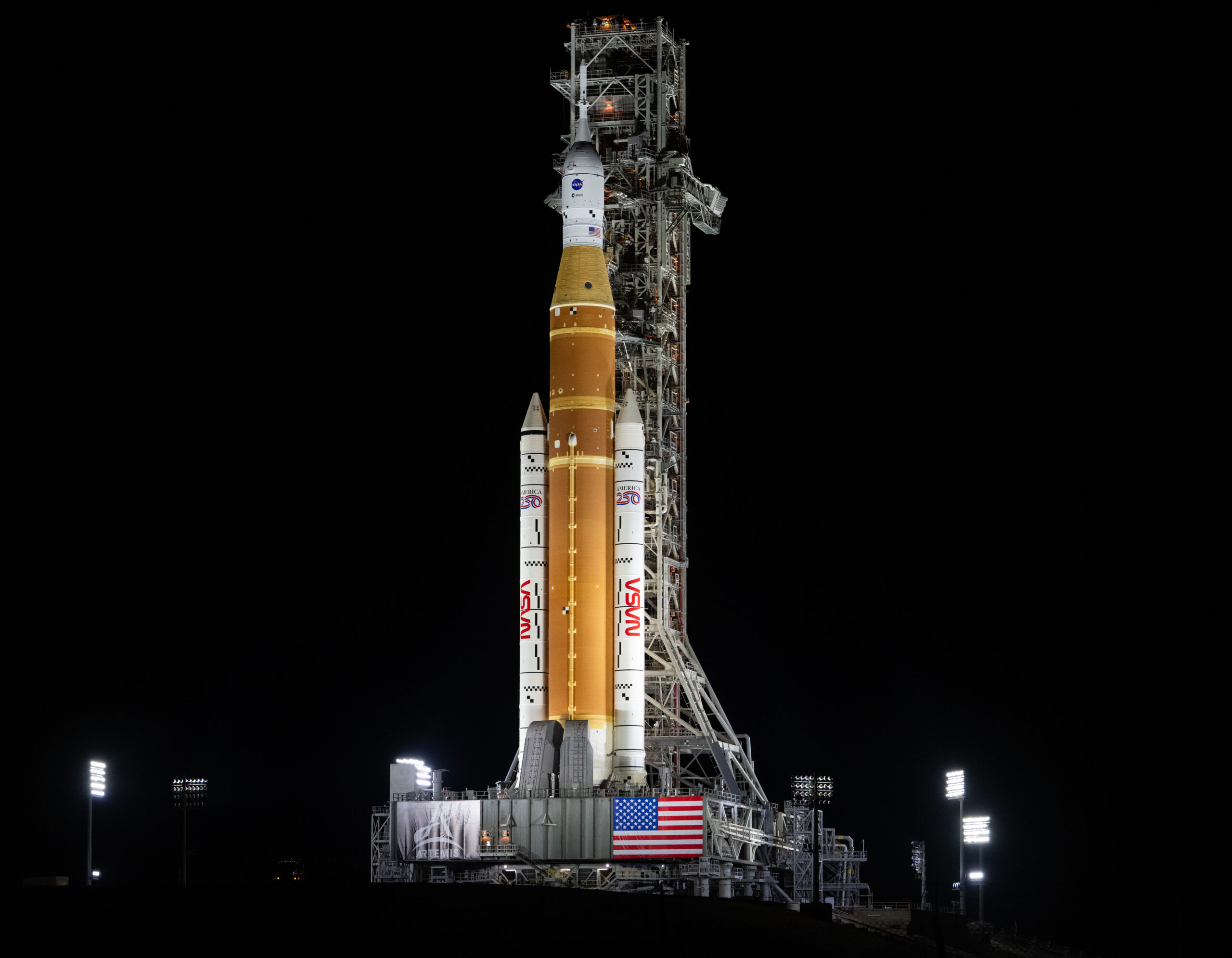
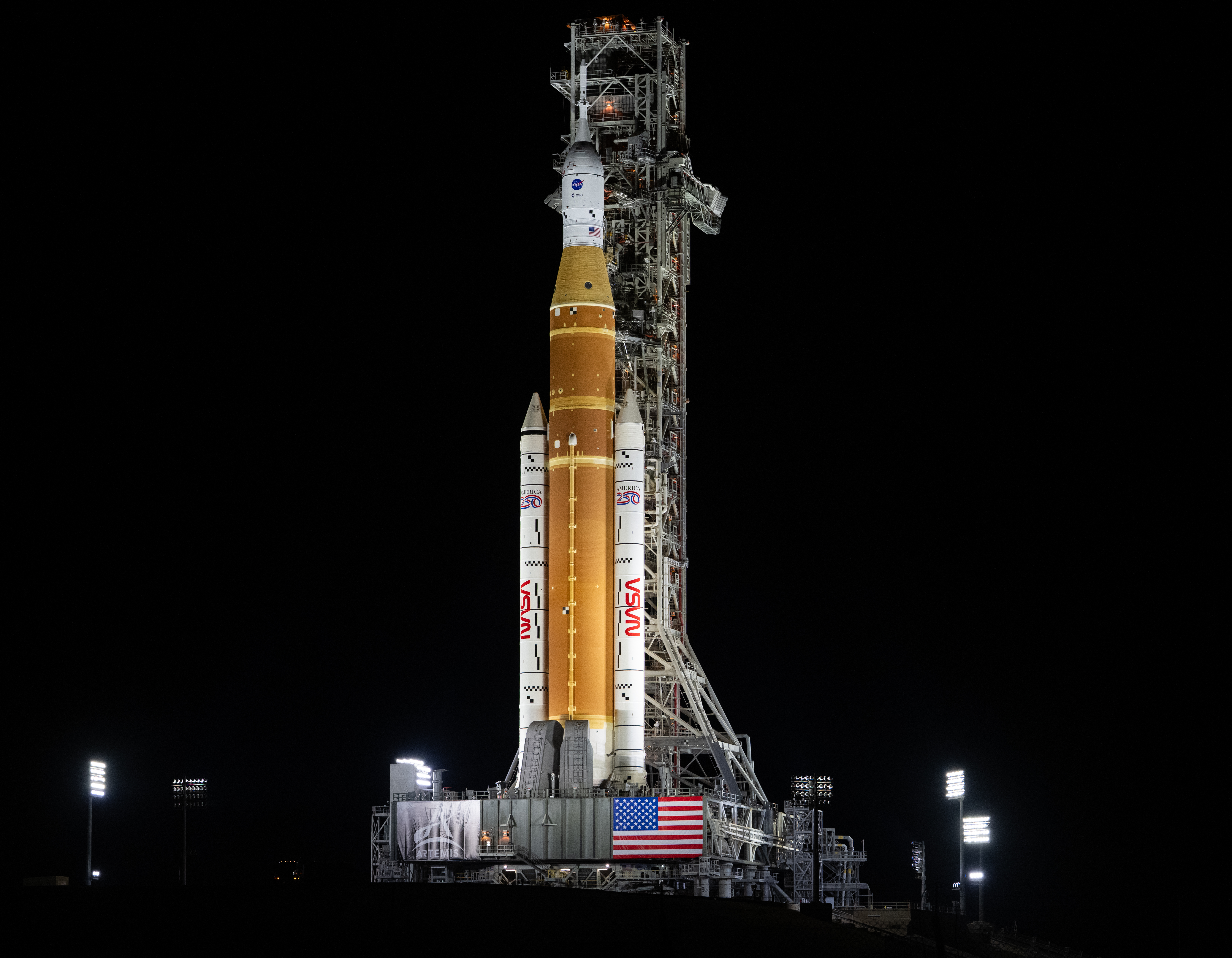
The countdown for the Artemis II wet dress rehearsal is underway at NASA’s Kennedy Space Center in Florida.
The countdown clock began at 8:13 p.m. EST, or L-48 hours, 40 minutes before the opening of a simulated launch window at 9 pm. Mon, Feb. 2. The test is expected to go until approximately 1 a.m. Feb. 3.
This test will run the launch team, as well as supporting teams in the Mission Control Center at NASA’s Johnson Space Center in Houston and other supporting NASA centers, through a full range of operations, including loading cryogenic liquid propellant into the SLS (Space Launch System) rocket’s tanks, conducting a launch countdown, demonstrating the ability to recycle the countdown clock, and draining the tanks to practice scrub procedures. These steps ensure the team is fully prepared for launch day.
A 24/7 live stream of the rocket at the pad continues online. NASA will provide a separate feed during tanking activities, as well as real-time blog post updates regarding the test during the fueling day.
Countdown Milestones
The countdown contains “L minus” and “T minus” times. “L minus” indicates how far away we are from liftoff in hours and minutes. “T minus” time is a sequence of events that are built into the countdown. Pauses in the countdown, or “holds,” are built into the countdown to allow the launch team to target a precise launch window, and to provide a cushion of time for certain tasks and procedures without impacting the overall schedule. During planned holds in the countdown process, the countdown clock is intentionally stopped and the T- time also stops. The L- time, however, continues to advance.
During the rehearsal, the team will execute a detailed countdown sequence. They will pause at T-1 minute and 30 seconds for up to three minutes, then resume until T-33 seconds before launch and pause again. After that, they will recycle the clock back to T-10 minutes and conduct a second terminal countdown to approximately T-33 seconds before ending the sequence. This process simulates real-world conditions, including scenarios where a launch might be scrubbed due to technical or weather issues. At the end of the test, the team will drain the propellant and review all data before setting an official target launch date.
While the Artemis II crew members are not participating in the wet dress rehearsal, crew milestones occurring during launch day will be incorporated into the test timeline and the Artemis closeout crew will practice their closeout operations, which include closing the Orion crew module and launch abort system hatches.
Below are some of the key events that take place at each milestone after the countdown
begins. All times are approximate for when these milestones are expected to occur.
L-49 hours 15 minutes and counting
- L-49H, 15M: The launch team arrives on their stations and the countdown begins
- L-48H40M: The countdown clock begins
- L-47H30M – L-38H30M: Fill the water tank for the sound suppression system
- L-48H45M – L-39H45M: Liquid Oxygen (LOX)/Liquid Hydrogen (LH2) system
preparations for vehicle loading - L-39H30M – L-38H45M: The core stage is powered up
- L-40H30M – L-39H: The interim cryogenic propulsion stage (ICPS) is powered
up - L-38H45M – L-34H30M: Final preparations of the four RS-25 engines
L-34 hours 30 minutes and counting
- L-33H45M – L-33H10M: The ICPS is powered down
- L-32H30M – L-28H30M: Charge Orion flight batteries to 100%
- L-30H30M – L-23H30M: Charge core stage flight batteries
- L-19H15M – L-17H45M: The ICPS is powered-up for launch
- L-19H30M – L-16H: Orion crew suit regulator leak checks
L-15 hours and counting
- L-14H30M – L-13H: All non-essential personnel leave Launch Complex 39B
- L-12H45M – 11H15M: Ground Launch Sequencer (GLS) activation
- L-13H15M – L-11H05M: Air-to-gaseous nitrogen (GN2) changeover and vehicle
cavity inerting
L-11 hours, 40 minutes and counting
- L-11H35M – L-9H20M: 2-hour 15-minute built in countdown hold begins
- L-11H40M – L-10H30M: Launch team conducts a weather and tanking briefing
- L-10H20M: Launch team decides if they are “go” or “no-go” to begin tanking the
rocket - L-10H10M – L-9H50M: Core stage LOX transfer line chilldown
- L-10H10M – L-9H25M: Core stage LH2 chilldown
- L-10H20M – L-9H: Orion cold soak
L-10 hours and counting - L-9H50M – L-9H10M: Core stage LOX main propulsion system chilldown
- L-9H25M – L-9H: Core stage LH2 slow fill start
- L-9H20M: Resume T-Clock from T-8H10M
- L-9H10M – L-8H55M: Core stage LOX slow fill
- L-9H – L-7H40M: Core stage LH2 fast fill
- L-8H55M – L-6H10M: Core stage LOX fast fill
- L-8H45M – L-8H10M: ICPS LH2 chilldown
- L-8H10M – L-7H25M: ICPS LH2 fast fill start
- L-7H45M – L-6H: ICPS LOX main propulsion system chilldown
- L-7H40M – L-7H30M: Core stage LH2 topping
- L-7H30M – terminal count: Core stage LH2 replenish
- L-7H25M – L-7H05M: ICPS LH2 vent and relief test
- L-7H05M – L-6H55M: ICPS LH2 tank topping start
- L-6H50M – terminal count: ICPS LH2 replenish
- L-6H10M – L-5H40M: Orion communications system activated (RF to mission
control) - L-6H10M – L-5H40M: Core stage LOX topping
L-6 hours and counting
- L-6H – L-5H15M: ICPS LOX fast fill
- L-5H40M – terminal count: Core stage LOX replenish
- L-5H15M – L-5H: ICPS LOX vent and relief test
- L-5H – L-4H40M: ICPS LOX topping
- L-5H40M: Stage pad rescue
- L-5H40M: Closeout crew assemble
- L-4H40M – terminal count: ICPS LOX replenish
- L-4H40M: All stages replenish
- L-4H40M: Start 40-minute built in hold
- L-4H40M-L-4H25M: Closeout crew to white room
- L-4H30M – L-4H20M: Crew Module hatch preps and closure
- L-4H20M – L-3H20M: Counterbalance mechanism hatch sealpress decay
checks - L-3H20M – L-2H40M: Crew Module Hatch service panel install/closeouts
- L-2H40M – L2H20M: Launch Abort System (LAS) Hatch closure for flight
- L-1H10M: Launch Director brief – Flight vehicle/TPS Scan results with CICE
- L-1H45M – L-1H40M: Closeout crew departs Launch Complex 39B
L-40 minutes and holding
- L-40M: Built in 30-minute countdown hold begins
L-25 minutes and holding
- L-25M: Transition team to Orion to Earth communication loop following final NTD
briefing - L-16M: The launch director polls the team to ensure they are “go” for launch
T-10 minutes and counting
- T-10M: Ground Launch Sequencer (GLS) initiates terminal count
- T-8M: Crew Access Arm retract
- T-6M: GLS go for core stage tank pressurization
- T-6M: Orion set to internal power
- T-5M57S: Core stage LH2 terminate replenish
- T-4M: GLS is go for core stage auxiliary power unit (APU) start
- T-4M: Core Stage APU starts
- T-4M: Core stage LOX terminate replenish
- T-3M30S: ICPS LOX terminate replenish
- T-3M10S: GLS is go for purge sequence 4
- T-2M02S: ICPS switches to internal battery power
- T-2M: Booster switches to internal batter power
- T-1M30S: Hold for three minutes to verify core stage certification hold time
- T-1M30S: Core stage switches to internal power
- T-1M20S: ICPS enters terminal countdown mode
- T-50S: ICPS LH2 terminate replenish
- T-33S: GLS sends “go for automated launch sequencer” command
- T-33S: GLS Cutoff/Recycle
Inside the terminal countdown, teams have a few options to hold the count if needed.
- The launch team can hold at 6 minutes for the duration of the launch window,
less the 6 minutes needed to launch, without having to recycle back to 10
minutes. - If teams need to stop the clock between T-6 minutes and T-1 minute, 30
seconds, they can hold for up to 3 minutes and resume the clock to launch. If
they require more than 3 minutes of hold time, the countdown recycles back to T-
10. - If the clock stops after T-1 minute and 30 seconds, but before the automated
launch sequencer takes over, then teams can recycle back to T-10 to try again,
provided there is adequate launch window remaining. - On launch day, after handover to the automated launch sequencer, any issue
that would stop the countdown would lead to concluding the launch attempt for
that day.