
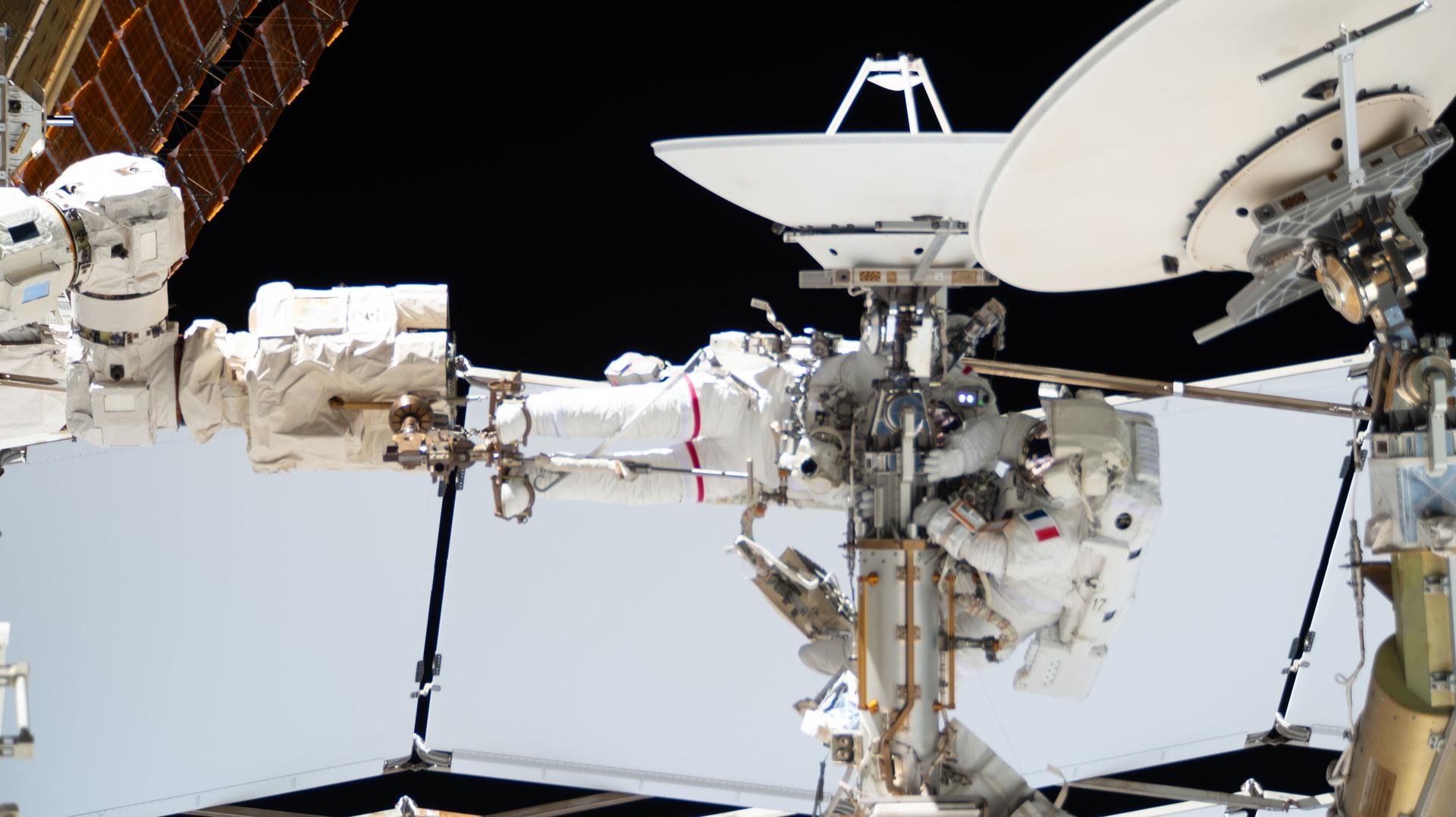
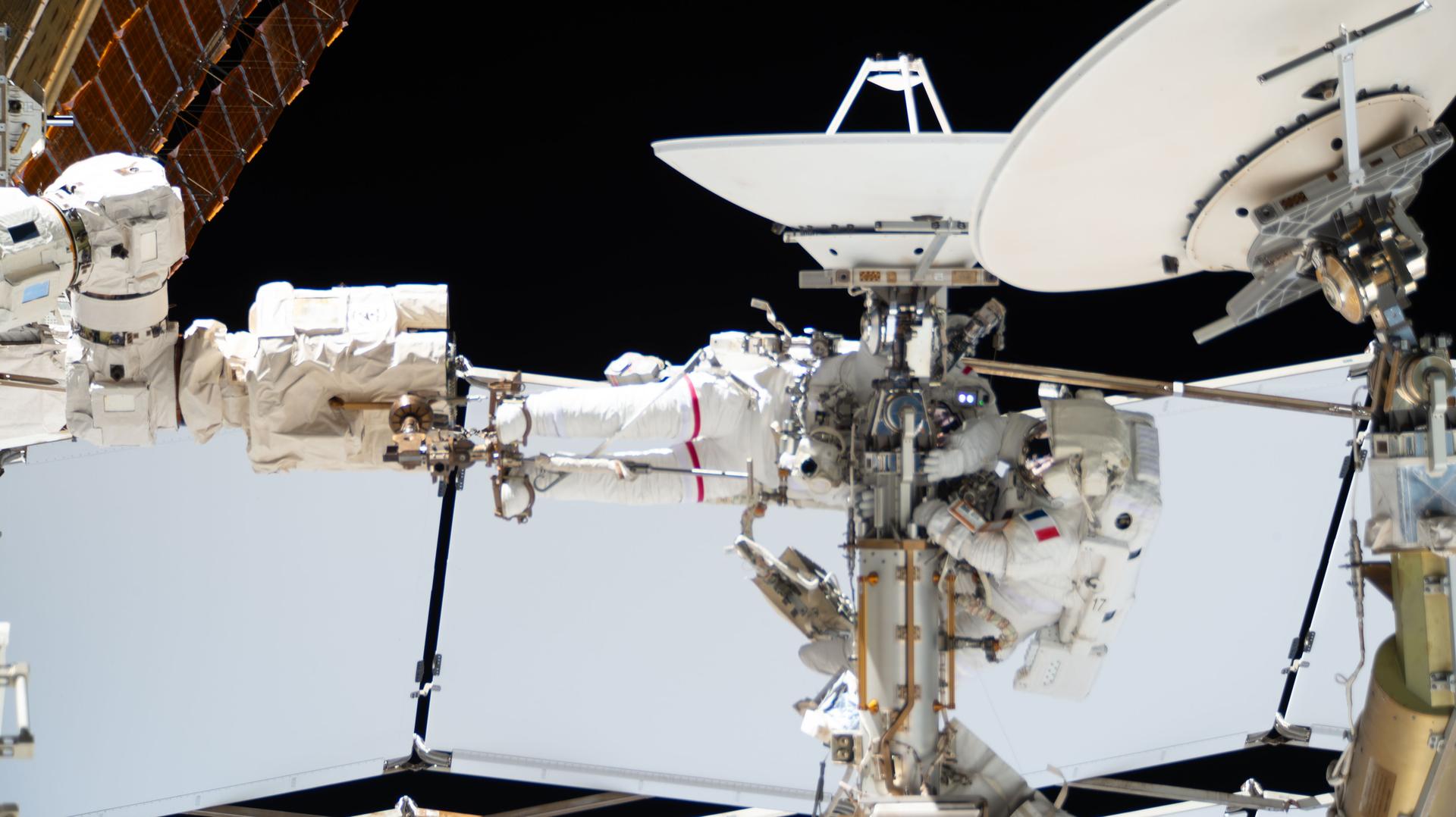
The Expedition 75 crew members cleaned up on Wednesday after a spacewalk that saw two astronauts uninstall an antenna outside the International Space Station. The lab residents also continued their microgravity research exploring the circulatory system, studying artificial intelligence, and photographing the Earth.
Flight engineers Anil Menon of NASA and Sophie Adenot of ESA (European Space Agency) are cleaning up after a six-hour and 23-minute spacewalk on Tuesday. During the spacewalk, the duo disconnected a failed high-speed antenna, then secured it with a long-duration tie down on the orbital outpost’s Z1 truss segment. A spare antenna will be installed in its place on the Z1 during a future spacewalk.
Adenot spent a portion of Wednesday inside the Quest airlock refilling spacesuit water tanks that provided cooling to the spacewalkers and their suit systems. Afterward, station commander Jessica Meir of NASA joined her in Quest and helped power down spacesuit components, remove suit batteries, and stow the suit hardware. At the end of Wednesday’s shift, the duo joined Menon and NASA flight engineer Jack Hathaway and called down to mission controllers to discuss their experience during the previous day’s spacewalk. All four astronauts had a couple of hours set aside throughout Wednesday to relax after Tuesday’s intense spacewalking and robotics activities.
While Adenot was servicing spacesuits on Wednesday, Menon was in the Columbus laboratory module conducting blood tests and vein scans with assistance from fellow astronauts Meir and Hathaway. Menon began his shift collecting his blood sample, spinning it in a centrifuge, then analyzing the sample with help from Meir. Next, he operated the Ultrasound 3 device and scanned Hathaway’s veins and measured his blood pressure as doctors on the ground monitored in real-time. The biomedical activities were part of the Venus Flow investigation that is exploring space-caused health risks to blood flow.
The space station’s three cosmonauts continued their science and maintenance activities for Roscosmos, their home space agency. The trio experienced trio focused on human research, advanced technology, and Earth observations while maintaining life support systems.
Flight engineer Andrey Fedyaev kicked off his shift wearing cuffs on his arm, wrist, and fingers to measure his blood pressure adding to the medical knowledge of microgravity’s effect on the circulatory system. Next, he pointed a multi-spectral camera at Earth and photographed North American lakes. Flight engineer Anna Kikina continued testing artificial intelligence tools to transcribe crew reports for review by Roscosmos mission controllers. Flight engineer Pyotr Dubrov attached electrodes to himself to measure his heart rate while he jogged on the Zvezda service module’s treadmill for a regularly scheduled fitness assessment.
Learn more about station activities by following the space station blog, @space_station on X, as well as the ISS Facebook and ISS Instagram accounts.
Get the latest from NASA delivered every week. Subscribe here.