
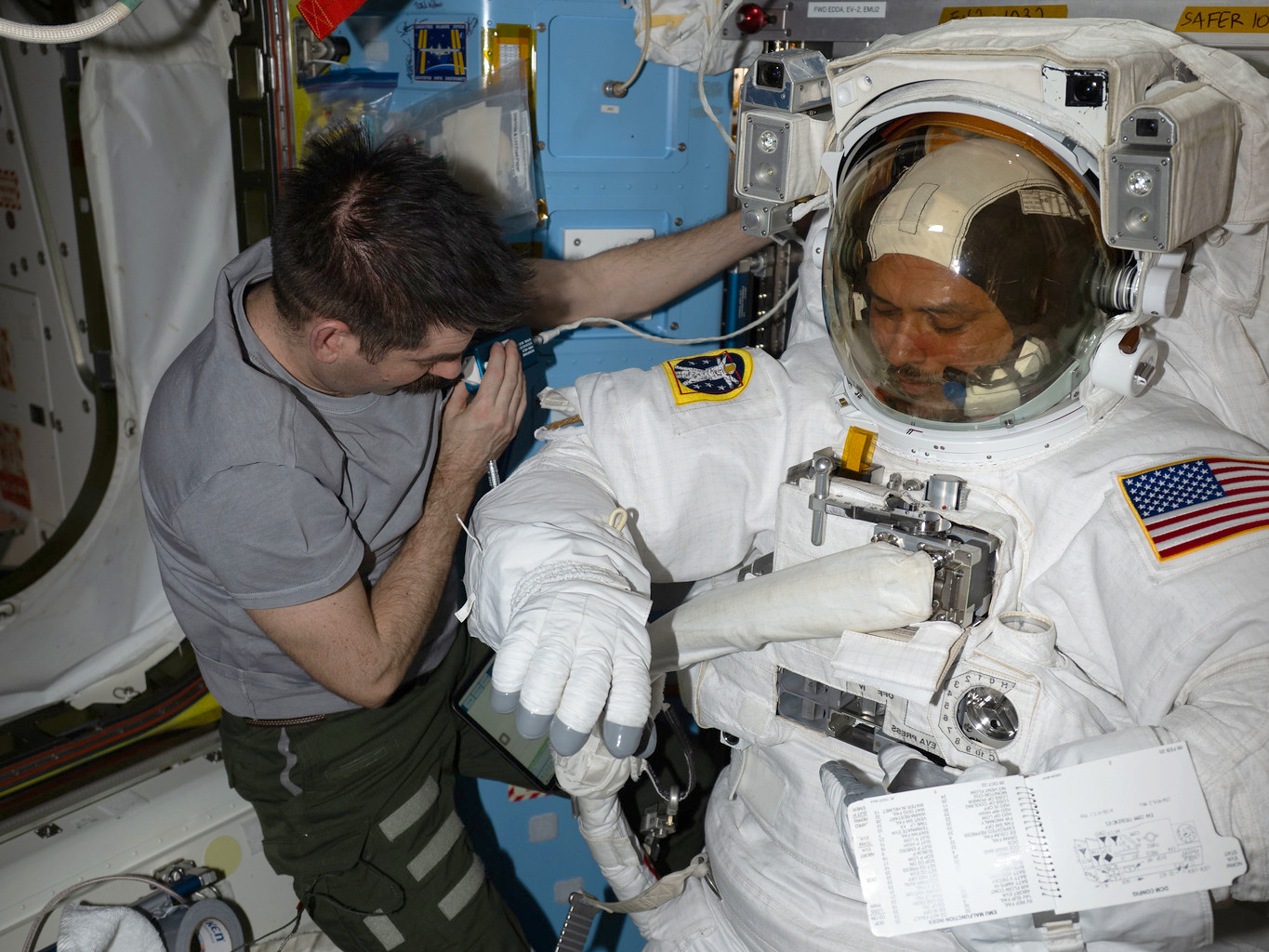
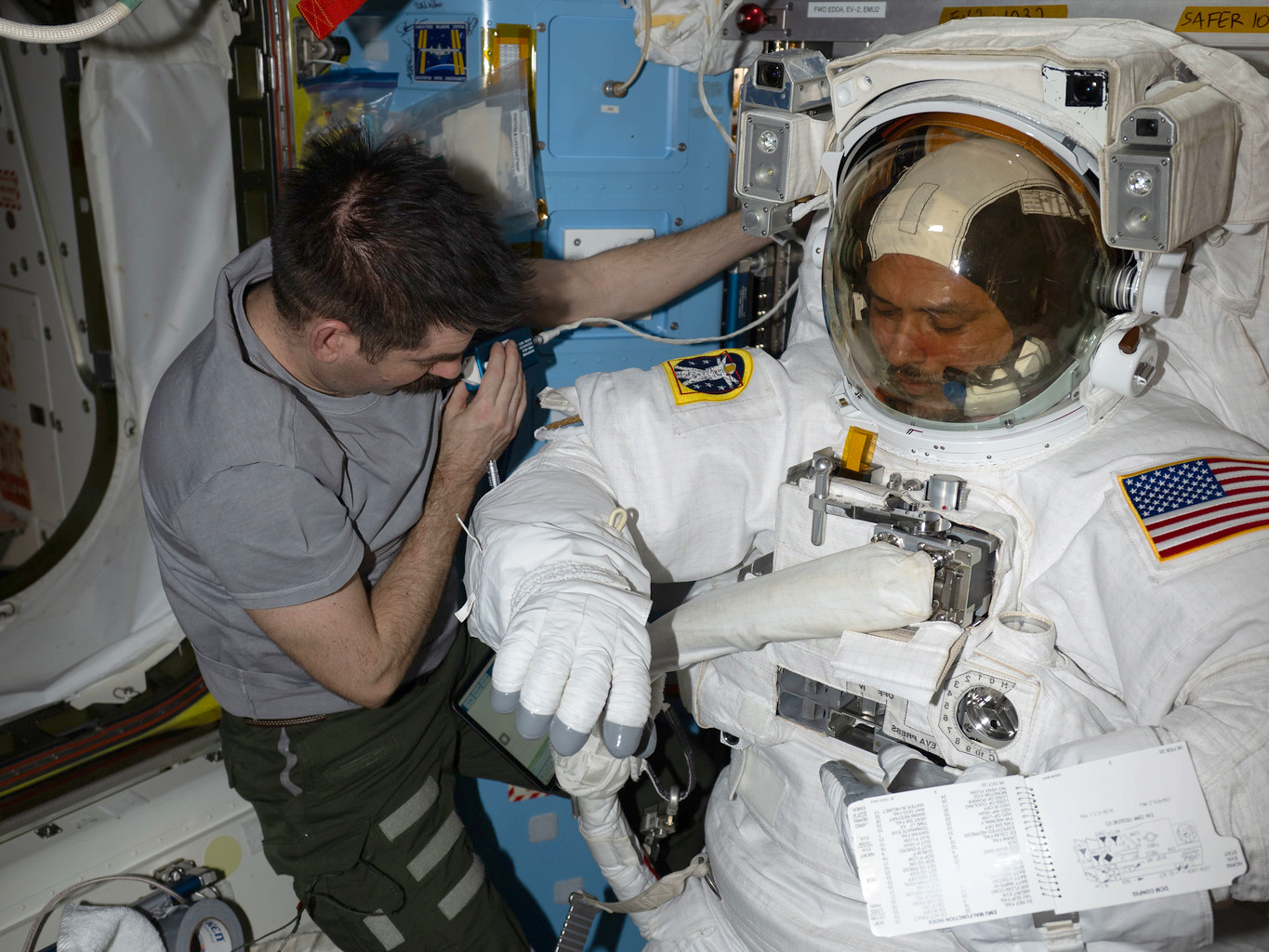
The Expedition 75 crew continued studying procedures and checking out spacesuits on Thursday for a spacewalk to replace a high-speed antenna on the outside of the International Space Station next week. High-tech science rounded out the schedule as the lab residents wore virtual reality goggles and tested artificial intelligence tools to benefit future space crews.
Astronauts Anil Menon of NASA and Sophie Adenot of ESA (European Space Agency) will venture into the vacuum of space after setting their spacesuits to battery power at 8:35 am. EDT on Tuesday, Aug. 18. The duo will exit the Quest airlock, translate to the Z1 truss segment on top of the Unity module, and swap out a space-to-ground antenna.
Flight engineer Jack Hathaway and station commander Jessica Meir, both from NASA, will assist the spacewalkers in and out of their spacesuits and operate the Canadarm2 robotic arm during the planned six-and-a-half-hour job. Menon will ride on the Canadarm2’s latching end effector as Adenot, tethered to the station’s truss structure, helps him uninstall the old antenna from the Z1. Next, the duo will retrieve the spare antenna from an external stowage platform then install it on Z1. Finally, the spacewalkers will stow the old antenna on the same external platform.
Menon and Hathaway partnered together on Thursday confirming the functionality of his spacesuit and refilling suit tanks and liquid cooling ventilation garments with water. Meir and Adenot studied the specialized tools the spacewalkers will use during the delicate electrical and data connections between the space-to-ground antenna and the Z1 truss.
The four astronauts also called down to mission controllers at the end of their shift on Thursday to discuss readiness for next week’s spacewalk including safety reminders, technical guidance, and a question-and-answer session. The quartet finally talked to robotics engineers to clarify the fine-tuned Canadarm2 maneuvering techniques and coordination with ground teams.
The orbital outpost’s three cosmonauts focused on space research using the latest technology to advance human spaceflight. Flight engineers Pyotr Dubrov and Anna Kikina took turns wearing a virtual reality headset and responding to computerized visual stimuli. The long-running Virtual experiment tests how a crew member’s sense of balance and direction adapts to microgravity. Dubrov also wrapped up an automated Earth photography session taken during the crew’s sleep shift. Kikina joined flight engineer Andrey Fedyaev and continued testing artificial intelligence tools that may boost crew efficiency aboard a spacecraft.
Learn more about station activities by following the space station blog, @space_station on X, as well as the ISS Facebook and ISS Instagram accounts.
Get the latest from NASA delivered every week. Subscribe here.