
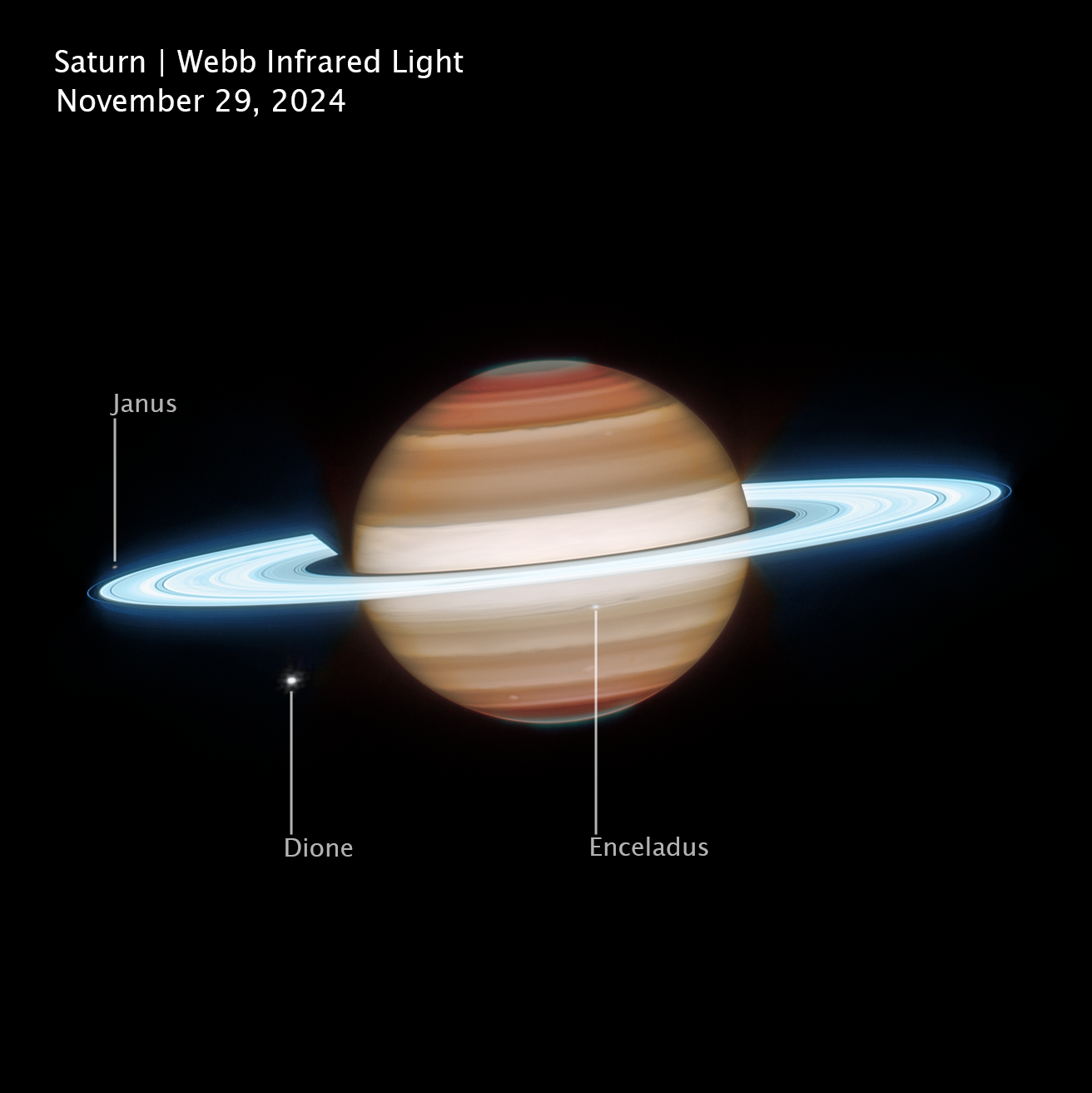
 Captured Nov. 29, 2024 by NASA’s James Webb Space Telescope, this infrared view of Saturn shows its glowing icy rings and layered atmosphere. Several moons are visible, including Janus, Dione, and Enceladus.NASA, ESA, CSA, STScI; Image Processing: Joseph DePasquale (STScI) Saturn’s icy rings glow in this infrared view from NASA’s James Webb Space Telescope released on March 25, 2026. Combining this image with another that NASA’s Hubble Space Telescope captured – also released on the same day – provides scientists with a richer, more layered understanding of the gas giant’s atmosphere.
In Webb’s infrared image, the rings are extremely bright because they are made of highly reflective water ice. In addition, Saturn’s poles appear distinctly grey-green, indicating light emitting at wavelengths around 4.3 microns. This feature could come from a layer of high-altitude aerosols in Saturn’s atmosphere that scatters light differently at those latitudes. Another possible explanation is auroral activity, as charged molecules interacting with the planet’s magnetic field can produce glowing emissions near the poles.
Read more about this image and what it, along with Hubble’s, can tell us about Saturn.
Image credit: NASA, ESA, CSA, STScI; Image Processing: Joseph DePasquale (STScI)