
Science hardware maintenance filled the day for the Expedition 74 crew following the release of two cargo spacecraft in less than a week at the International Space Station. The orbital residents also continued more reviews for next week’s spacewalk, kept up their ongoing human research program, and readied another spacecraft for departure.
Northrop Grumman’s Cygnus XL cargo spacecraft completed its resupply mission to the orbital outpost when the Candarm2 robotic arm released it into Earth orbit at 7:06 a.m. EDT on Thursday, March 12. It will reenter the atmosphere for a fiery, but safe demise above the South Pacific Ocean on Saturday. JAXA’s (Japan Aerospace Exploration Agency) HTV-X1 cargo spacecraft left the space station on Friday, March 6, when the Canadarm2 released it. HTV-X1 will orbit Earth for several more weeks of remotely controlled science experiments before an atmospheric reentry above the South Pacific.
Working inside the orbiting lab’s Kibo laboratory module, NASA flight engineers Chris Williams and Jack Hathaway completed the workweek servicing a variety of research gear ensuring continuous operations of microgravity science. Williams swapped a large centrifuge for a smaller centrifuge inside Kibo’s Saibo rack to support future biology experiments. Hathaway replaced an obsolete high-definition video camera with an upgraded one inside Kibo’s airlock that will be placed outside of the station to capture Earth imagery and spacecraft arriving and departing at the orbital outpost.
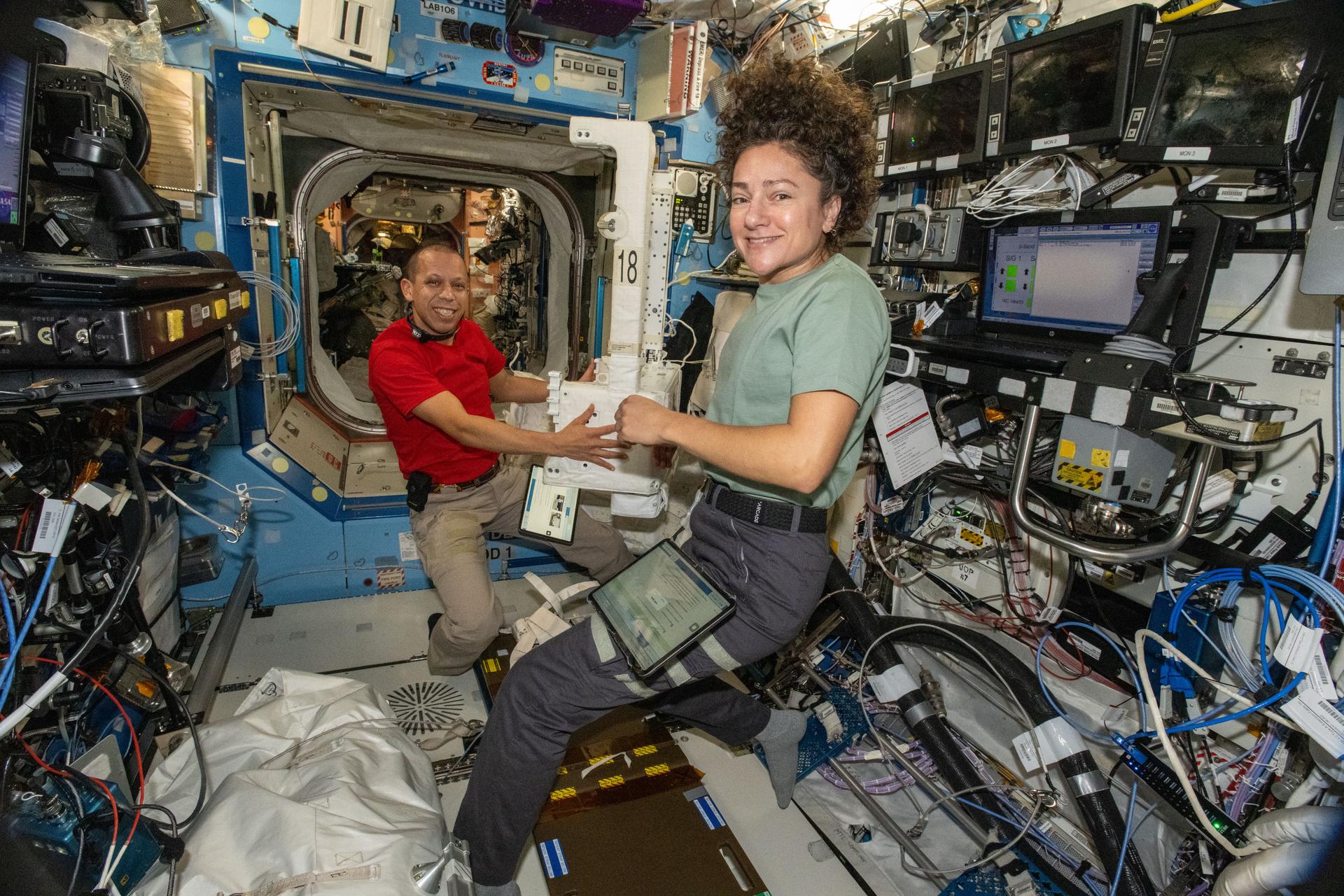
Williams then joined NASA flight engineer Jessica Meir at the end of their shift and called down to mission controllers to discuss procedures for a spacewalk scheduled on Wednesday, March 18. The team reviewed the spacewalking tools and tasks necessary to install a modification kit and route cables on the port side of the orbital outpost. The external maintenance work will enable the next roll-out solar array to be installed on a future spacewalk after it is delivered on a SpaceX Dragon spacecraft.
Earlier, Meir began her shift with flight engineer Sophie Adenot of ESA (European Space Agency) in the Columbus laboratory module and helped her set up the PhysioTool health monitoring experiment. Meir helped Adenot attach portable sensors on her body measuring a variety of health parameters including heart, lung, and brain activity. Results may enable more comprehensive biomedical data of the effects of living and working in weightlessness.
Roscosmos cosmonauts Sergey Kud-Sverchkov and Sergei Mikaev wrapped up a weeklong cardiac study observing how weightlessness impacts a crew member’s circulatory system. The station commander and flight engineer, respectively, once again attached sensors on their forehead, fingers, and toes that sent their blood flow data by Bluetooth adaptor to a laptop computer for analysis. Kud-Sverchkov started his shift checking the operation of lights throughout the station’s Roscosmos segment. Mikaev prepared the trash-packed Progress 92 cargo spacecraft for its upcoming departure by disconnecting docking components and closing the hatch.
Roscosmos flight engineer Andrey Fedyaev kicked off his shift replacing orbital plumbing components and checking their functionality inside the Zarya module. Next, Fedyaev transferred fluids between tanks and removed air bubbles as part of maintenance for the Zvezda service module’s Elektron oxygen generator. Finally, the two-time station resident filmed his crewmates as they were going about science, maintenance, and exercise activities to document life onboard the International Space Station.
The International Space Station is orbiting higher today after the Progress 93 cargo spacecraft, docked to the Zvezda service module’s aft port, fired its engines for 10 minutes, 30 seconds at 11:58 a.m. EDT. The reboost increased the space station’s altitude by half a mile at apogee and nine-tenths of a mile at perigee, leaving the station in an orbit of 266 x 257 statute miles.