

3 Min Read Meet NASA’s Astronaut Class of 2025 – Webby Submission 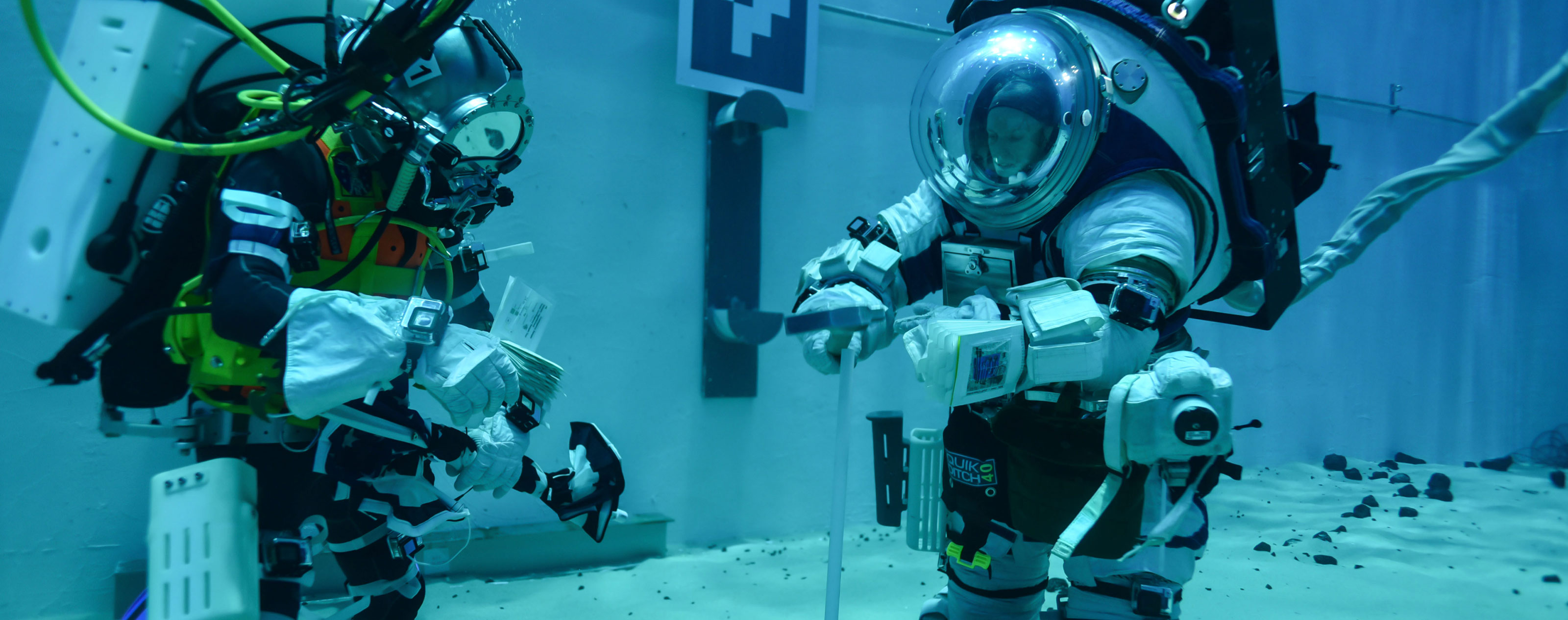 Teams are evaluating how to train for lunar surface operations during Artemis missions, in the Neutral Buoyancy Lab at Johnson Space Center in Houston. Credits: NASA NASA engineers are laying the foundation for the moonwalks the first woman and next man will conduct when they land on the lunar South Pole in 2024 as part of the Artemis program. At the agency’s Johnson Space Center in Houston, teams are testing the tools and developing training approaches for lunar surface operations.
As part of a test series occurring in the Neutral Buoyancy Lab (NBL) at Johnson, astronauts in a demonstration version of the exploration spacesuit and engineers in “hard hat” dive equipment are simulating several different tasks crew could do on the surface of the Moon.
As part of a test series occurring in the Neutral Buoyancy Lab (NBL) at Johnson, astronauts in a demonstration version of the exploration spacesuit and engineers in “hard hat” dive equipment are simulating several different tasks crew could do on the surface of the Moon.
This early testing will help determine the best complement of facilities for hardware development and requirements for future Artemis training and missions  DAREN WELSH
EVA Flight Controller & Crew Instructor
 The tests are focused on evaluating Johnson’s facilities for Artemis spacewalk testing, development, and crew training. Astronauts are practicing a variety of tasks, including picking up samples of lunar regolith, examining a lunar lander, and planting an American flag. There are many fundamentals that the teams have to consider and work through, such as how crew might get up and down a ladder safely, how to swing a hammer safely, and how to conduct successful moonwalks in different lighting conditions than the Apollo-era moonwalks. The tests will inform future mission planning, including how many spacewalks to conduct during a mission, how long they’ll be, and how far away from a lander the crew will travel.
While NASA has extensive experience preparing astronauts for spacewalks in microgravity like those to construct and maintain the International Space Station over the past 20 years, preparing for Moon missions comes with different challenges.
We can evaluate tools in a lab or the rock yard, but you can learn so much when you put a pressurized spacesuit on and have to work within the limitations of its mobility. Daren Welsh
EVA Flight Controller & Crew Instructor
 There is a lot of work to do to get the facilities ready to work for lunar missions and figure out how to facilitate the training Daren Welsh
EVA Flight Controller & Crew Instructor
In addition to testing in the NBL, teams also are using different analog environments to simulate lunar conditions. Tests are occurring at Johnson’s rock yard, a large, outdoor test area which simulates general features of the lunar surface terrain.
Rock yard testing is a critical analog environment for spacewalk tool development and operations. The interaction between the crewmembers and the Earth-based teams in mission control and the science control centers allows engineers to mature concepts of mission operations. The testing reveals spacewalking tool design improvements and helps formulate operational timelines. Analog environments allow iterations on designs to occur quickly such that the revisions can be reevaluated in subsequent tests.
“We have experience with space station, but we need to determine how we’re going to train the crew for surface operations during these specific missions,” Welsh said. “There is a lot of work to do to get the facilities ready to work for lunar missions and figure out how to facilitate the training.”
This collaborative effort is already paying dividends for the team as they are becoming more familiar with the surface operation concepts. As the tests continue, the team is expanding the scope of the testing, with plans to complete full lunar spacewalk timelines.
With the Artemis program, NASA will land the first woman and next man on the Moon in 2024, using innovative technologies to explore more of the lunar surface than ever before. We will collaborate with our commercial and international partners and establish sustainable exploration by the end of the decade. Then, we will use what we learn on and around the Moon to take the next giant leap – sending astronauts to Mars.
About the Author Kelcie Nicole Howren
 4 min read Moon Mascot: NASA Artemis II ZGI Design Challenge Article 1 day ago
  9 min read 2025 in Review: Highlights from NASA in Silicon Valley Article 1 day ago
  3 min read NASA’s DiskSat Technology Demo Launches to Low Earth Orbit Article 1 day ago
 Keep Exploring Discover More Topics From NASA Missions



