
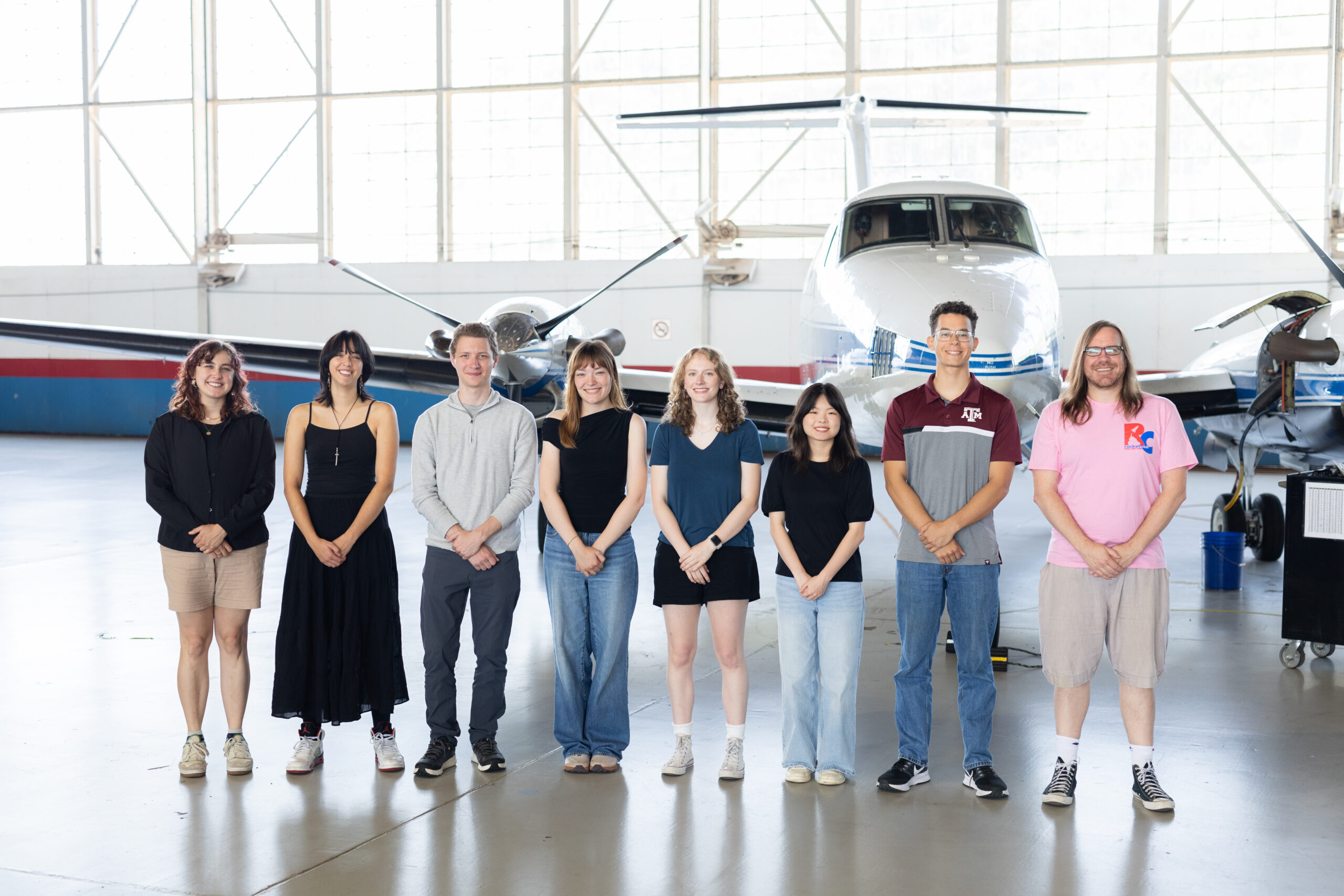
Preparations for Next Moonwalk Simulations Underway (and Underwater)  The 2025 SARP East Oceans Group poses in front of the Dynamic Aviation B-200 aircraft, parked in a hangar at NASA’s Wallops Flight Facility in Virginia. During the internship, students spend a week engaged in Earth science data collection and learning from instruments specialists while flying onboard both the B-200 and NASA’s P-3 aircraft.NASA/Milan Loiacono Return to 2025 SARP Closeout Faculty Advisors:
Tom Bell, Woods Hole Oceanographic Institute
Graduate Mentor:
Sarah Lang, University of Rhode Island
Oceans Group Introduction Faculty Advisor Tom Bell and Graduate Mentor Sarah Lang
Isabella Showman Detecting Coastal Sea Ice Extent and Freshet Event Timing in Prudhoe Bay, Alaska Using Sentinel-1 C-SAR Isabella Showman, University of Washington
The detachment of coastal sea ice due to increasing upstream snowmelt causes dramatic seasonal changes in the Arctic Ocean. Termed a freshet, these freshwater pulses influence the timing of sea ice degradation, but the effects are difficult to quantify because of frequent cloud cover and limited ground observations. Sentinel-1 C-SAR (Synthetic Aperture Radar) collects high-spatiotemporal data using microwave radiation backscatter allowing it to see through clouds, making it a valuable tool to identify freshet timing in the Arctic.
We used SAR imagery to classify seasonal sea ice extent for a 45 km transect north of Prudhoe Bay, Alaska. The backscatter signature of SAR is influenced by roughness, and since ocean water is smoother than ice, the backscatter differences allow for the estimation of proportional sea ice cover along the transect. We validated the accuracy of our SAR classifications using shortwave infrared from cloud-free Sentinel-2 images, and found strong agreement between the methods. We then calculated the average annual percent ice cover from 2017 to 2024, serving as a seasonal baseline to compare against individual years. We found mean sea ice decline throughout the spring and summer months and associated freshet event timing to begin in the middle of June. The rate of decline in sea ice cover along the transect has higher variability in the weeks following the onset of sea ice melt.
The use of SAR to track localized seasonal ice melt and identify the timing of spring freshet events allows for a more complete seasonal time series than optical imagery alone. Variability in Arctic freshet timing influences how and when sea ice degradation begins, having potential implications for organisms reliant on sea ice extent and larger-scale surface albedo. This study also lays the groundwork for future investigations to better understand across- watershed variability and environmental factors like river discharge and surface temperature on freshet timing.
Sarah Gryskewicz Investigating the Impacts of the January 2025 California Wildfires on Phytoplankton Blooms in the Pacific Ocean Sarah Gryskewicz, State University of New York at Oswego
Wildfires are increasing in frequency and intensity across North America as a result of climate change. The release of particulates by these events result in short-range and long-range implications on human and ecophysiological health. Marine ecosystems may also be impacted due to the deposition of these chemical constituents, particularly ash, which can alter nutrient cycling in the water by fertilization and reduce light availability for phytoplankton. Phytoplankton are microscopic organisms that live in marine waters and are responsible for half of the photosynthetic activity on Earth. An area of complex interdisciplinary research concerns the interactions between wildfires and the marine ecosystem. There is a large scientific need to understand biogeochemical cycling between wildfire emissions and phytoplankton blooms.
This study investigates the January 2025 California wildfire impacts on phytoplankton blooms offshore the southern California coast in nutrient limited waters. The Visible Infrared Imaging Radiometer Suite (VIIRS) onboard the Suomi National Polar-orbiting Partnership (SNPP) satellite is used to assess interannual and seasonal variabilities while the Plankton, Aerosol, Cloud, ocean Ecosystem (PACE) satellite was utilized for the additional ocean-based analyses. Variables considered include chlorophyll-a (chl-a) as a proxy for phytoplankton biomass, particulate organic carbon (POC) to assess phytoplankton physiology, and diffuse attenuation at 490 nm (Kd490) to assess light availability. From this analysis, it was found that there was no evident fertilization of a phytoplankton bloom given that chl-a eight-day composites did not deviate significantly from 2012-2025 average geometric mean concentrations. Analyses of the chl-a:POC and chl-a:Kd490 ratios suggest a potential physiological or phytoplankton community shift, but future work using in-situ data is necessary to connect wildfires impacts on phytoplankton communities offshore Southern California. Additionally, the research sets the stage for future work using PACE to investigate impacts on phytoplankton community groups. Future research also involves the expansion of sample wildfire cases and consideration of forested versus urban emission impacts.
Philip Espinal How Well Can Machine Learning Forecast Kelp Biomass Along the Central California Coast? Philip Espinal, Texas A&M University
Giant Kelp is an integral part of the coastal ecosystem off the Central California Coast because it provides food and shelter for several marine organisms, and supports a multi-million dollar commercial fishing industry. In recent decades, Giant Kelp forests have been in decline due to warming ocean temperatures and overgrazing by marine organisms such as sea urchins. Conservation efforts like outplanting, transplanting, and sea urchin removal are occurring in an effort to restore Giant Kelp populations along the California Coast. Knowing when the environment will be favorable for kelp growth is important to focus conservation resources and effort most efficiently. Observations from the Landsat series of satellites allow for the estimation of kelp biomass density going back to 1984. Two machine learning algorithms, random forests and a simple neural network, were trained on the Landsat observations, coastal wave model output, climate indices, and reanalysis products from 1984 to 2015. Models were evaluated on the mean absolute error (MAE) for predictions from 2016 to 2021, as well the MAE and mean absolute percent error (MAPE) of just the third quarters, when maximum biomass density is typically achieved. The random forest models showed little skill even at the minimum forecast horizon of one quarter, performing similar to a prediction made by a 5-year rolling seasonal average. The neural networks performed significantly better than the random forests and seasonal averages when forecasting one quarter into the future, and performed marginally better at two and four quarters into the future. The neural network trained to forecast one quarter ahead had a third quarter MAPE of 13.4% while the 5-year seasonal average had a MAPE of 42.8%. Models performed poorly in the area surrounding Monterey, greatly overestimating the amount of kelp biomass. This overprediction may be due to the severe reduction in kelp biomass since 2015 due to sea urchin overgrazing. While the predictions did not match the actual outcome, the environment may have in fact still been productive for kelp if not for the presence of sea urchins. Overall, these models can serve as a proof of concept that machine learning models, especially neural networks, can use current environmental conditions to forecast kelp biomass one to two quarters into the future, providing useful operational guidance for conservationists.
Carolyn Chen Sea Surface Temperature as an Indicator of Benthic Symbiont Loss in the Florida Keys: A Comparative Analysis of ECOSTRESS and MODIS Carolyn Chen, University of Florida
Coral bleaching events, which pose significant threats to marine biodiversity and reef structure, have increased in frequency and severity over recent decades. Accurate monitoring of sea surface temperature is vital for understanding the drivers of zooxanthellae loss in these foundational habitats. Traditional methods of satellite temperature data collection have relatively coarse spatial resolution (1 km). This can obscure finer-scale thermal variability, especially in nearshore and coastal reef environments where localized temperature anomalies may lead to significant biological impacts. Here, we use ECOSTRESS at a fine spatial resolution (70 m) to investigate the relationships between sea surface temperature and bleaching in the Florida Keys. Thermal imagery from July 24, 2023 was spatially overlaid with in situ coral bleaching survey data to investigate potential thermal stress–bleaching relationships. We then quantified this relationship through correlation analyses at varying spatial thresholds, examining the strength and direction of associations between sea surface temperature and corresponding levels of coral bleaching intensity across survey sites. Parallel analyses were conducted using MODIS for comparative assessment. We were able to determine that ECOSTRESS sea surface temperature had a weak association with bleaching intensity (r² = 0.348, p