
Explore Hubble Hubble Home Overview About Hubble The History of Hubble Hubble Timeline Why Have a Telescope in Space? Hubble by the Numbers At the Museum FAQs Impact & Benefits Hubble’s Impact & Benefits Science Impacts Cultural Impact Technology Benefits Impact on Human Spaceflight Astro Community Impacts Science Hubble Science Science Themes Science Highlights Science Behind Discoveries Hubble’s Partners in Science Universe Uncovered AI and Hubble Science Explore the Night Sky Observatory Hubble Observatory Hubble Design Mission Operations Missions to Hubble Hubble vs Webb Team Hubble Team Career Aspirations Hubble Astronauts Multimedia Images Videos Sonifications Podcasts e-Books Online Activities 3D Hubble Models Lithographs Fact Sheets Posters Hubble on the NASA App Glossary News Hubble News Social Media Media Resources More 35th Anniversary Online Activities 2 min read
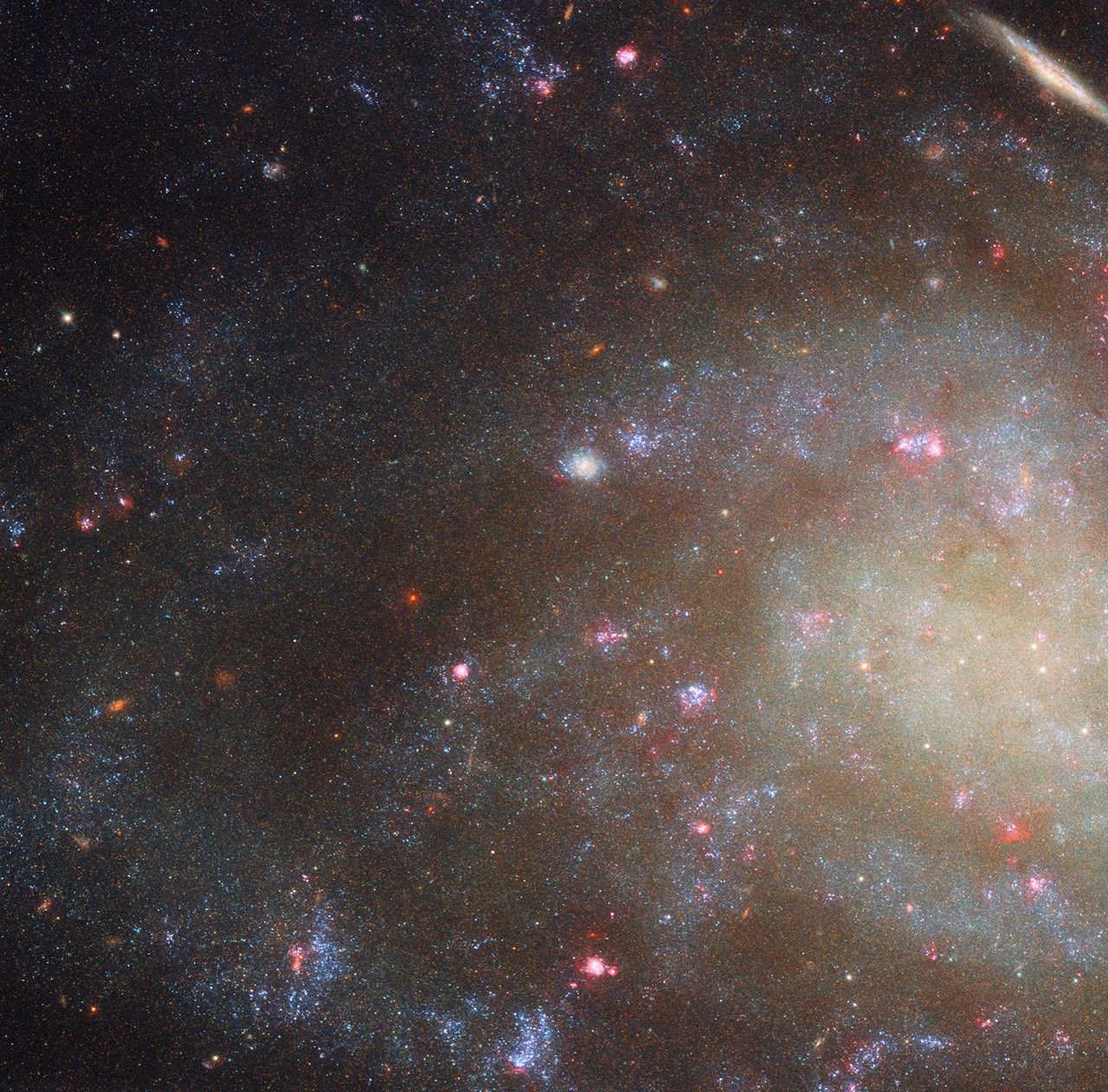
Hubble Examines Low Brightness, High Interest Galaxy 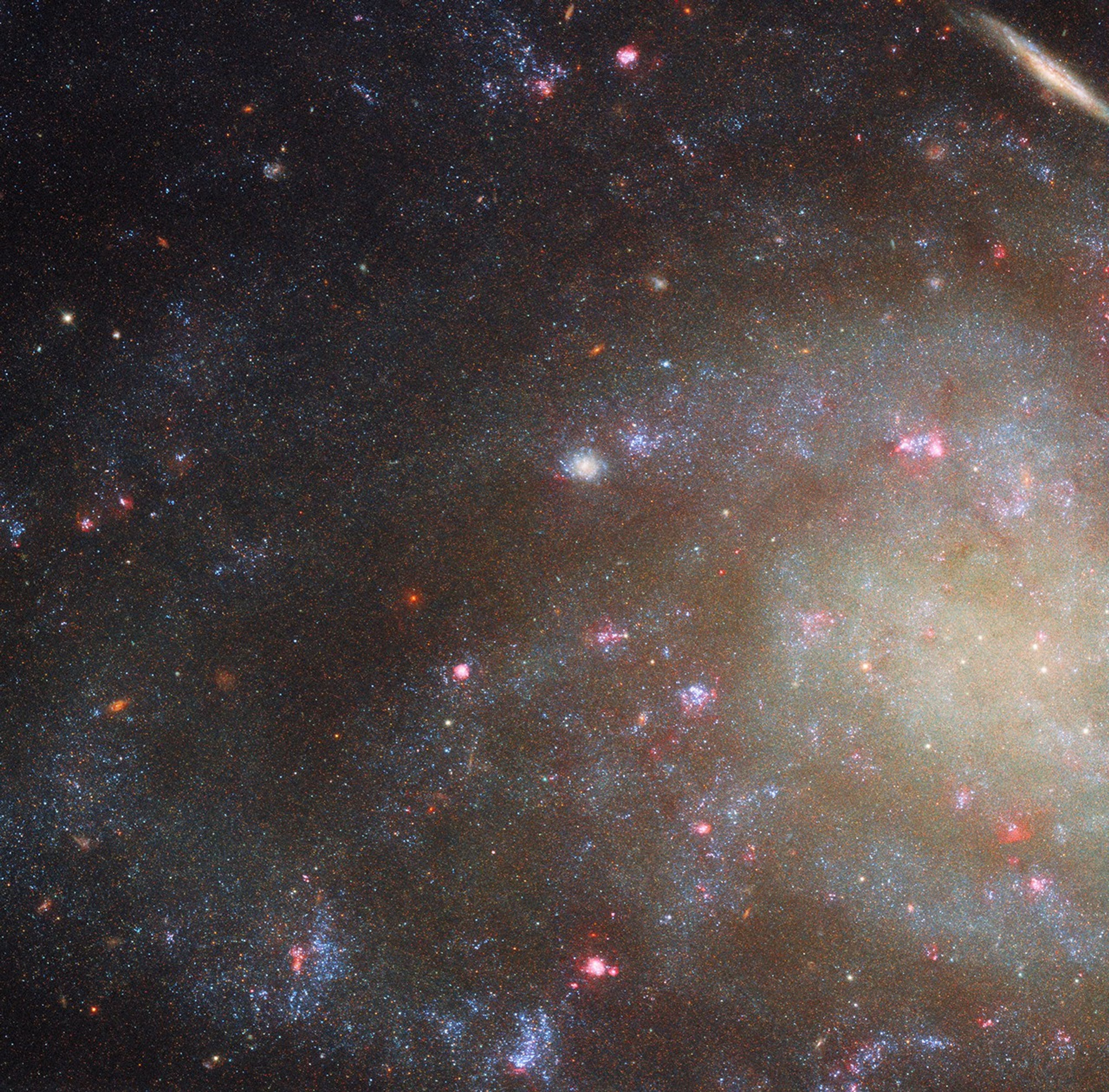 This NASA/ESA Hubble Space Telescope image features a portion of the spiral galaxy NGC 45. ESA/Hubble & NASA, D. Calzetti, R. Chandar; Acknowledgment: M. H. Özsaraç This NASA/ESA Hubble Space Telescope image zooms in on the feathery spiral arms of the galaxy NGC 45, which lies just 22 million light-years away in the constellation Cetus (the Whale).
The portrait uses data drawn from two complementary observing programs. The first took a broad view of 50 nearby galaxies, leveraging Hubble’s ability to observe ultraviolet through visible into near-infrared light to study star formation in these galaxies. The second program examined many of the same nearby galaxies as the first, narrowing in on a particular wavelength of red light called H-alpha. Star-forming nebulae are powerful producers of H-alpha light, and several of these regions are visible across NGC 45 as bright pink-red patches.
These observing programs aimed to study star formation in galaxies of different sizes, structures, and degrees of isolation — and NGC 45 is a particularly interesting target. Though it may appear to be a regular spiral galaxy, NGC 45 is a remarkable type called a low surface brightness galaxy.
Low surface brightness galaxies are fainter than the night sky itself, making them incredibly difficult to detect. They appear unexpectedly faint because they have relatively few stars for the volume of gas and dark matter they carry. In the decades since astronomers serendipitously discovered the first low surface brightness galaxy in 1986, researchers have learned that 30–60% of all galaxies may fall into this category. Studying these hard-to-detect galaxies is key to understanding how galaxies form and evolve, and Hubble’s sensitive instruments are equal to the task.
Text Credit: ESA/Hubble
Facebook logo @NASAHubble @NASAHubble Instagram logo @NASAHubble
Details Last Updated Aug 14, 2025 Editor Andrea Gianopoulos Location NASA Goddard Space Flight Center Related Terms Astrophysics Astrophysics Division Galaxies Galaxies, Stars, & Black Holes Hubble Space Telescope Spiral Galaxies Star-forming Nebulae Stars The Universe
Keep Exploring Discover More Topics From Hubble 35 Years of Hubble Images

/Hubble%20Space%20Telescope%20(A).png?w=1920&h=1080&fit=clip&crop=faces%2Cfocalpoint)
